ORION vs GMX: A Comprehensive Comparison of Decentralized Trading Protocols and Their Market Performance


Introduction: ORION vs GMX Investment Comparison
In the cryptocurrency market, comparisons between ORION and GMX have always been a focal point for investors. The two projects not only differ significantly in market capitalization ranking, application scenarios, and price performance, but also represent distinct positioning within the crypto asset landscape. ORION (ORION): This project aims to establish a cross-chain stablecoin bank supported by an ecosystem of dApps and infrastructure, enabling seamless stablecoin savings, lending, and consumption across multiple chains. GMX (GMX): Positioned as a decentralized perpetual exchange, GMX serves as both a utility and governance token, capturing 30% of platform-generated fees, making it a revenue-generating asset within its ecosystem. This article will provide a comprehensive analysis of the investment value comparison between ORION and GMX through examining historical price trends, supply mechanisms, ecosystem adoption, and market dynamics, while addressing the question investors are most concerned with:
"Which is the better buy right now?"
Orion Money (ORION) vs GMX Market Analysis
I. Historical Price Comparison and Current Market Status
Orion Money (ORION) and GMX Historical Price Trends
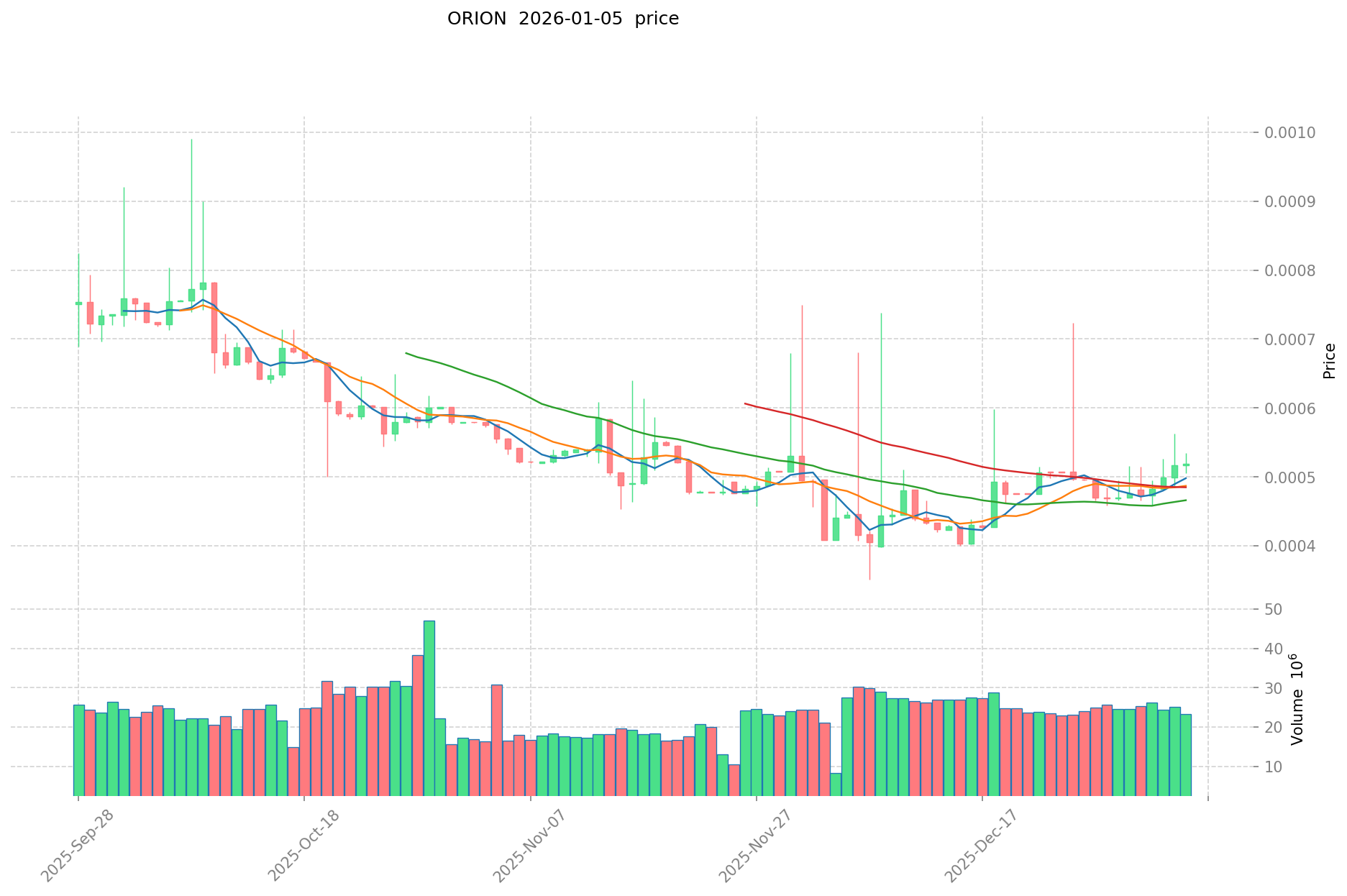
- October 2021: ORION reached its all-time high of $2.36 on October 15, 2021, driven by initial market enthusiasm during the bull market cycle.
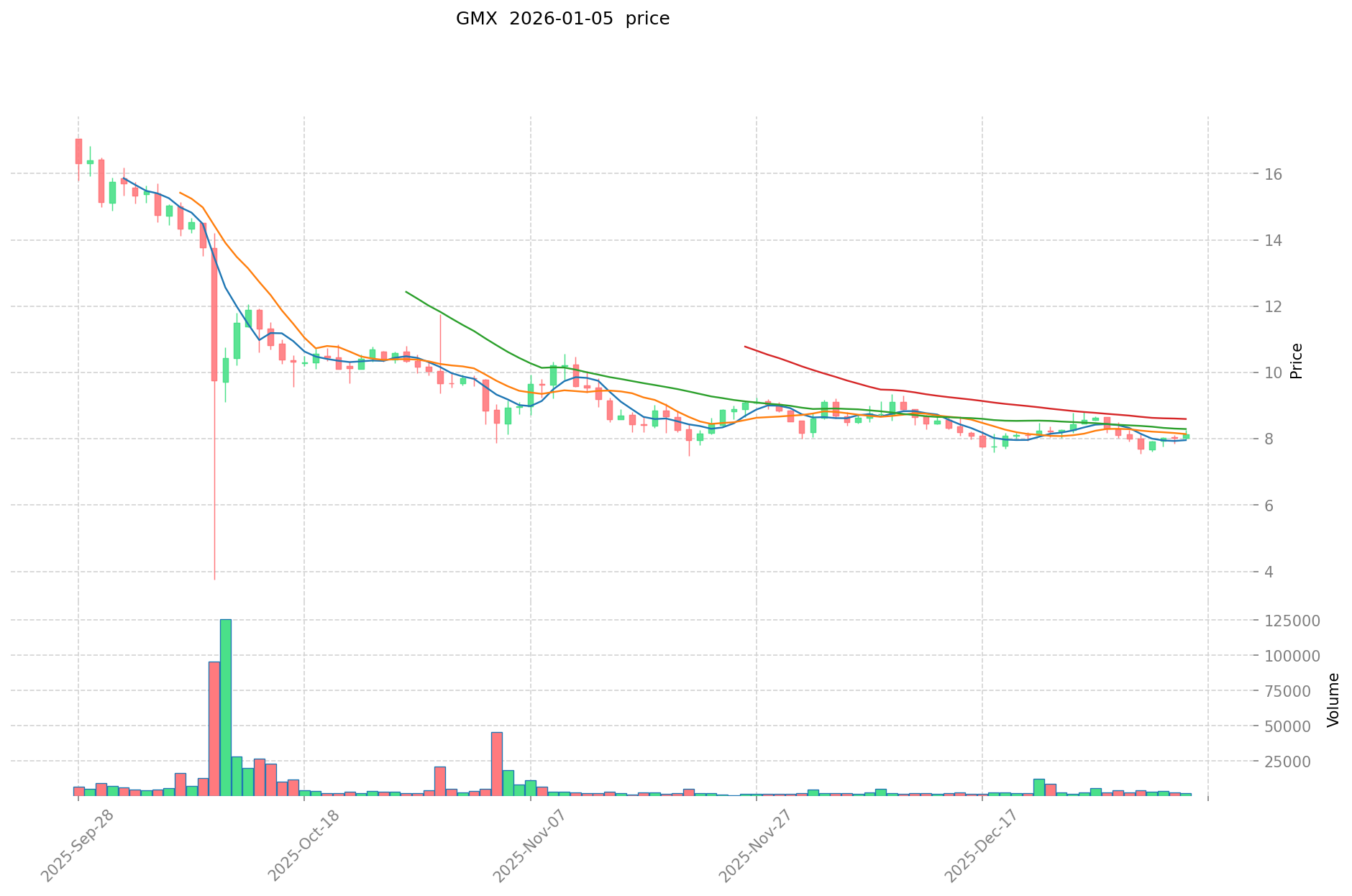
- April 2023: GMX achieved its all-time high of $91.07 on April 18, 2023, reflecting peak market valuation for the decentralized exchange token.
- December 2025: ORION declined to its all-time low of $0.00038237 on December 7, 2025, representing a significant contraction from peak levels.
- October 2025: GMX reached its low point of $6.92 on October 11, 2025, during a market downturn period.
- Comparative analysis: Over the market cycle from 2021 to 2026, ORION declined from $2.36 to $0.0005058, representing a loss of approximately 99.98%, while GMX decreased from $91.07 to $8.106, representing a loss of approximately 91.09%.
Current Market Situation (January 5, 2026)
- ORION current price: $0.0005058.
- GMX current price: $8.106.
- 24-hour trading volume: ORION recorded $11,968.44 versus GMX's $25,001.05.
- Market sentiment index (Fear & Greed Index): 26 (Fear).
Click to view real-time prices:
- View ORION current price Market Price
- View GMX current price Market Price
II. Core Factors Influencing ORION vs GMX Investment Value
Supply Mechanism Comparison (Tokenomics)
- ORION: Cross-chain stablecoin banking mechanism focused on maintaining stable value through collateralized reserves and multi-chain stability protocols
- GMX: DeFi protocol with native governance token supporting leveraged trading and liquidity provision on Arbitrum
- 📌 Historical Pattern: Stablecoin mechanisms prioritize capital preservation, while DeFi governance tokens exhibit volatility tied to platform activity and trading volume cycles
Institutional Adoption and Market Application
- Institutional Holdings: GMX demonstrates stronger institutional traction through its established position as a leading decentralized perpetual futures protocol on Arbitrum, where it commands over 30% of TVL. ORION targets institutional investors initially with potential future retail expansion following regulatory approval
- Enterprise Adoption: GMX provides leveraged trading and margin trading services; ORION enables cross-chain stablecoin banking and settlement infrastructure. GMX has shown expansion potential into physical gold investment for accredited investors, while ORION focuses on stablecoin interoperability across multiple blockchains
- National Policy: Both protocols operate within decentralized finance frameworks subject to evolving global cryptocurrency regulations. Future regulatory approvals will determine expansion capabilities, particularly for real-world asset integration like physical gold investment
Technology Development and Ecosystem Building
- ORION Technology Development: Cross-chain stablecoin architecture enabling interoperability across multiple blockchain networks, strengthening its position as cross-chain banking infrastructure
- GMX Technology Development: Leveraged perpetual futures protocol with established liquidity pools on Arbitrum, supporting margin trading infrastructure with proven technical stability
- Ecosystem Comparison: GMX maintains dominant DeFi positioning on Arbitrum with significant TVL concentration. ORION operates as cross-chain stablecoin settlement infrastructure. Both serve specialized niches within the broader DeFi ecosystem, with GMX focused on trading derivatives and ORION on stablecoin banking services
Macroeconomic Environment and Market Cycles
- Performance Under Inflation: ORION's stablecoin foundation provides inflation-resistant characteristics through collateralized value preservation. GMX's performance correlates with risk asset appetite and trading activity volatility
- Macroeconomic Monetary Policy: Both assets respond to interest rate cycles and USD strength. Declining rate environments typically increase DeFi activity and leverage appetite, benefiting GMX. Stablecoin demand (ORION's focus) strengthens during market uncertainty and flight-to-safety periods
- Geopolitical Factors: Demand for cross-chain stablecoin solutions increases during geopolitical tensions affecting international settlement channels. GMX leveraged trading activity responds to broader cryptocurrency market sentiment influenced by macroeconomic conditions
III. 2026-2031 Price Forecast: ORION vs GMX
Short-term Forecast (2026)
- ORION: Conservative $0.0004-$0.000527 | Optimistic $0.000527-$0.000527
- GMX: Conservative $5.12-$8.12 | Optimistic $8.12-$9.67
Mid-term Forecast (2028-2029)
- ORION may enter accumulation phase, projected price range $0.000382-$0.000949
- GMX may enter growth phase, projected price range $8.75-$12.85
- Key drivers: institutional capital inflow, ETF adoption, ecosystem development
Long-term Forecast (2030-2031)
- ORION: Base scenario $0.000541-$0.000949 | Optimistic scenario $0.000733-$0.001292
- GMX: Base scenario $7.93-$13.21 | Optimistic scenario $8.15-$15.56
ORION:
| 年份 | 预测最高价 | 预测平均价格 | 预测最低价 | 涨跌幅 |
|---|---|---|---|---|
| 2026 | 0.000527176 | 0.0005069 | 0.000400451 | 0 |
| 2027 | 0.00065663826 | 0.000517038 | 0.0004136304 | 2 |
| 2028 | 0.000704205756 | 0.00058683813 | 0.0003814447845 | 16 |
| 2029 | 0.00094891725621 | 0.000645521943 | 0.00036794750751 | 27 |
| 2030 | 0.000948691323529 | 0.000797219599605 | 0.000733442031636 | 57 |
| 2031 | 0.001291974083119 | 0.000872955461567 | 0.000541232386171 | 72 |
GMX:
| 年份 | 预测最高价 | 预测平均价格 | 预测最低价 | 涨跌幅 |
|---|---|---|---|---|
| 2026 | 9.66637 | 8.123 | 5.11749 | 0 |
| 2027 | 9.33941925 | 8.894685 | 7.56048225 | 9 |
| 2028 | 11.1228035925 | 9.117052125 | 8.75237004 | 12 |
| 2029 | 12.8523083806125 | 10.11992785875 | 8.6019386799375 | 24 |
| 2030 | 13.209035837633437 | 11.48611811968125 | 7.925421502580062 | 41 |
| 2031 | 15.557946993108253 | 12.347576978657343 | 8.149400805913846 | 52 |
IV. Investment Strategy Comparison: ORION vs GMX
Long-term vs Short-term Investment Strategy
- ORION: Suitable for investors focusing on cross-chain infrastructure development, stablecoin ecosystem adoption, and long-term value preservation through collateralized reserve mechanisms
- GMX: Suitable for investors seeking exposure to DeFi trading activity, institutional adoption on Arbitrum, and revenue-generating governance token participation
Risk Management and Asset Allocation
- Conservative investors: ORION 30% vs GMX 70%
- Aggressive investors: ORION 50% vs GMX 50%
- Hedging tools: Stablecoin reserves, options strategies, multi-chain diversification
V. Potential Risk Comparison
Market Risk
- ORION: Extreme volatility from near-zero valuations ($0.0005058), limited trading liquidity ($11,968.44 daily volume), and concentrated market sentiment exposure during risk-off periods
- GMX: Correlation with cryptocurrency market cycles and leveraged trading dynamics on Arbitrum, exposure to DeFi protocol competition and trading volume fluctuations
Technology Risk
- ORION: Cross-chain interoperability vulnerabilities, smart contract security across multiple blockchain networks, protocol upgrade execution risks
- GMX: Perpetual futures liquidation cascades during extreme market volatility, liquidity pool concentration on Arbitrum, margin trading infrastructure stability
Regulatory Risk
- Both protocols operate within evolving global cryptocurrency regulatory frameworks. ORION faces additional scrutiny for stablecoin banking functionality and cross-chain settlement infrastructure. GMX encounters regulatory challenges regarding leveraged derivatives trading and decentralized exchange operations. Jurisdictional restrictions could limit institutional adoption and platform expansion capabilities.
VI. Conclusion: Which Is the Better Buy?
📌 Investment Value Summary:
- ORION advantages: Cross-chain stablecoin infrastructure positioning, inflation-resistant collateralized mechanisms, potential institutional adoption following regulatory approval, long-term ecosystem development potential
- GMX advantages: Established DeFi market leadership on Arbitrum, proven revenue-generating governance model (30% fee capture), stronger institutional traction, greater trading liquidity and market depth
✅ Investment Recommendations:
- Beginner investors: Prioritize GMX for established protocol credibility, higher liquidity, and clearer revenue mechanics; allocate ORION minimally for diversification
- Experienced investors: Consider ORION for asymmetric upside potential in cross-chain banking infrastructure; maintain GMX for DeFi exposure and yield generation strategies
- Institutional investors: GMX offers established governance participation and TVL concentration on Arbitrum; ORION requires further regulatory clarity and ecosystem validation before significant allocation
⚠️ Risk Disclaimer: Cryptocurrency markets exhibit extreme volatility. This analysis does not constitute investment advice. Both assets carry substantial risk including potential capital loss.
FAQ
ORION和GMX分别是什么?各自的主要功能和定位有什么区别?
ORION是去中心化交易聚合器,提供跨链交易和流动性聚合服务。GMX是衍生品交易平台,专注于永续合约和杠杆交易。ORION强调交易效率和最优价格,GMX定位于衍生品市场,提供高杠杆交易功能。两者都在Web3交易领域占据重要地位,但服务方向不同。
ORION和GMX的交易手续费如何对比?哪个更便宜?
ORION的交易手续费通常低于GMX,因此ORION更便宜。ORION提供更具竞争力的费率结构,适合追求降低交易成本的用户。
ORION和GMX支持的交易品种和杠杆倍数有什么不同?
ORION支持多种加密资产,最高杠杆100倍;GMX同样提供多个交易对,最高杠杆也是100倍。两者杠杆倍数相同,但支持的具体交易品种和资产类别存在差异。
ORION和GMX的流动性和交易深度哪个更好?
GMX交易深度和流动性通常更优,提供更稳定的交易体验。ORION则通过流动性聚合技术优化交易路由,两者各有所长,建议根据具体交易需求选择。
ORION和GMX在安全性和风险管理方面有什么差异?
ORION采用零知识证明技术,提升交易安全性与验证速度,风险管理更加透明。GMX则采用传统风险管理方法。ORION的技术架构在安全防护上具有更强的优势。
我应该选择ORION还是GMX?各自适合什么类型的交易者?
ORION适合注重易用性的新手和中级交易者,提供友好界面和基础工具。GMX适合专业技术交易者,提供深度图表分析和高级功能。选择ORION求简洁,选GMX求专业。
Share
Content
Introduction: ORION vs GMX Investment Comparison
I. Historical Price Comparison and Current Market Status
II. Core Factors Influencing ORION vs GMX Investment Value
III. 2026-2031 Price Forecast: ORION vs GMX
IV. Investment Strategy Comparison: ORION vs GMX
V. Potential Risk Comparison
VI. Conclusion: Which Is the Better Buy?
FAQ
How to Buy Cryptocurrency



World Liberty Financial (WLFI) Investment Guide: Stablecoin rewards and trading strategies on Gate.

XPL Focus: Why Derivations Drive Its Rapid Rise

Is Perpetual Protocol (PERP) a Good Investment?: A Comprehensive Analysis of Its Long-term Potential in the DeFi Derivatives Market
Perpetual Futures DEX Innovation: How Gate Perp DEX Reshapes the Decentralization Trading Experience
Top 5 Perpetual DEXs: Exploring the Future of Decentralized Trading

MPLX vs DYDX: Comparing Two Leading Decentralized Derivatives Exchanges in the Crypto Market

Is Crypto Legal in Netherlands?

Marina Protocol Daily Quiz Answer for 7 january 2026

Spur Protocol Daily Quiz Answer Today 7 january 2026

Top dApps in The Open Network (TON) Ecosystem
Dropee Question of the Day for 7 january 2026