In the cryptocurrency market, price volatility has long been a major barrier to widespread adoption. While leading cryptocurrencies like Bitcoin and Ethereum offer strong liquidity, their frequent price swings limit their usefulness in payments, settlements, and value storage. As a result, stablecoins, designed to maintain a consistent value, have become a foundational component of the blockchain financial ecosystem.
Among them, USDC stands out as one of the most important USD-pegged stablecoins, thanks to its transparent reserve structure and strong regulatory alignment. Issued by Circle, USDC is widely used in crypto trading, DeFi protocols, cross-border payments, and on-chain dollar settlements. It plays a critical role as a liquidity layer in the on-chain financial system. Understanding how USDC works helps explain how stablecoins enable both price stability and efficient capital flow within blockchain ecosystems.
What Is the Core Mechanism Behind USDC?
At its core, USDC operates on a 1:1 USD reserve backing model. This means that for every 1 USDC issued, the issuer, Circle, holds $1 worth of reserve assets.
These reserves typically consist of cash and short-term U.S. Treasury securities, ensuring both high liquidity and strong security. This structure allows USDC to maintain a stable value anchored to the US dollar.
How Is USDC Issued?
When users or institutions deposit USD with Circle, the company issues an equivalent amount of USDC on-chain at a 1:1 ratio.
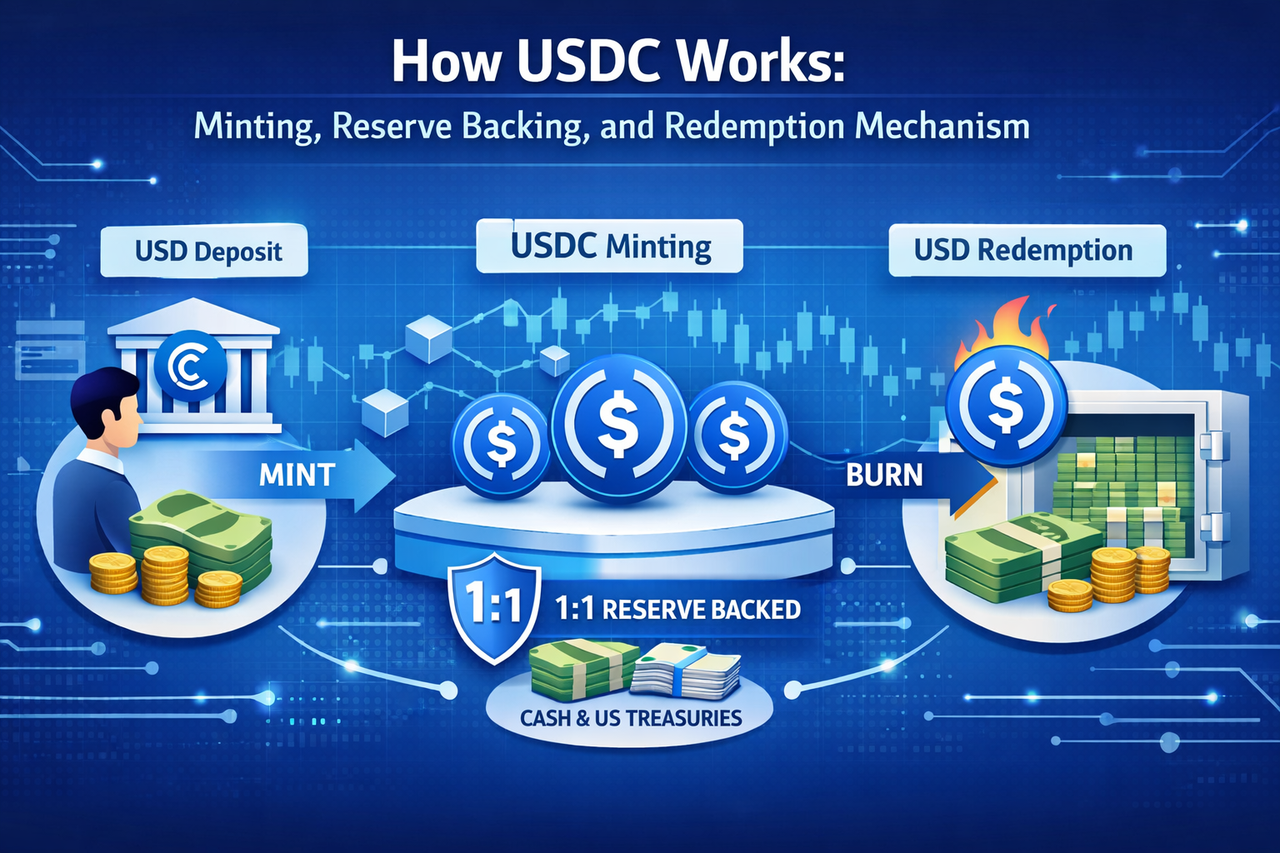
For example, if a user deposits $10,000, the system mints 10,000 USDC and sends it to the user’s wallet address. This process is known as minting and is the primary way USDC enters circulation.
How Does USDC Get Burned and Redeemed?
When users want to convert USDC back into USD, they can submit a redemption request to Circle.
Once Circle receives the returned USDC, it burns the corresponding tokens and transfers the equivalent amount of USD back to the user. This process is known as burning. Through this mint-and-burn mechanism, USDC’s circulating supply always stays aligned with its reserve assets, helping maintain price stability.
How Does USDC Maintain Its 1:1 Peg to the USD?
In addition to reserve backing, USDC relies on market arbitrage to maintain price stability.
When USDC trades above $1, institutions can deposit USD with Circle to mint USDC and sell it on the market for a profit. This increases supply and pushes the price back down.
Conversely, when USDC trades below $1, market participants can buy USDC and redeem it for USD through Circle. This reduces supply and drives the price back up.
Through this arbitrage mechanism, USDC typically stays very close to its $1 peg.
How Are USDC Reserves Managed?
Market trust in USDC largely depends on transparent reserve management. Circle regularly publishes reserve reports, disclosing the composition of assets backing USDC.
These reserves typically include:
This level of transparency strengthens market confidence and has contributed to USDC’s widespread adoption among institutions and DeFi users.
What Are the Risks of the USDC Model?
Although USDC operates on a relatively robust model, it is not without risks.
First is reserve risk. If financial institutions holding the reserves face liquidity issues, USDC’s redemption capability could be affected.
Second is de-pegging risk. If market confidence in the reserves weakens, USDC may temporarily deviate from its $1 value.
There are also regulatory and smart contract risks. Changes in regulations could impact its issuance and circulation, while on-chain operations may be exposed to technical vulnerabilities.
FAQs
How is USDC issued?
When users deposit USD with Circle, the company issues an equivalent amount of USDC at a 1:1 ratio.
Why does USDC maintain a stable price?
Because it is backed by USD reserves and supported by market arbitrage mechanisms that keep its price close to $1.
What assets back USDC?
Primarily cash, short-term U.S. Treasury securities, and other highly liquid USD-denominated assets.
Who issues USDC?
USDC is issued and managed by Circle.
Is USDC safe?
Overall, it is considered relatively safe, but it still carries risks, including reserve risk, de-pegging risk, regulatory risk, and smart contract vulnerabilities.