A decentralized lending protocol is a fundamental component of the DeFi ecosystem. On-chain lending marketplaces allow users to deposit idle assets into a protocol to earn returns, or pledge assets as collateral to borrow funds, thereby increasing capital efficiency. As the DeFi market matures, lending protocols have become a key source for stablecoin liquidity management and protocol yield.
Among various lending protocols, Aave stands out as a leading open lending marketplace, while Spark (SPK) is a yield-focused protocol built around the Sky ecosystem. Both offer deposit returns and collateralized lending services, but they differ significantly in protocol positioning, sources of return, and ecosystem objectives.
| Comparison Dimension |
Spark (SPK) |
Aave |
| Protocol Positioning |
Stablecoin lending and yield protocol for the Sky ecosystem |
General-purpose DeFi lending protocol for the entire market |
| Core Objective |
Boost stablecoin capital efficiency and create an ecosystem yield loop |
Offer an open, multi-asset lending marketplace |
| Main Target User |
Sky ecosystem stablecoin users |
All DeFi lending users |
| Supported Asset Types |
Primarily stablecoins |
Supports stablecoins and a range of crypto assets |
| Sources of Return |
Stablecoin borrowing interest and internal liquidity demand |
Interest from multi-asset lending demand |
| Return Characteristics |
Relatively stable returns |
Higher elasticity and volatility in returns |
| Source of Liquidity |
Internal Sky ecosystem stablecoin liquidity |
Open market liquidity |
| Risk Levels |
Ecosystem concentration risk |
Market volatility risk |
| Protocol Advantages |
High stablecoin yield efficiency and strong ecosystem synergy |
Diverse assets and deep market liquidity |
| Suitable Users |
Users seeking stable returns and who are bullish on the Sky ecosystem |
Users seeking flexible lending and diversified asset allocation |
| Ecosystem Role |
Yield engine for the Sky ecosystem |
General DeFi lending infrastructure |
How do Spark and Aave differ in protocol positioning?
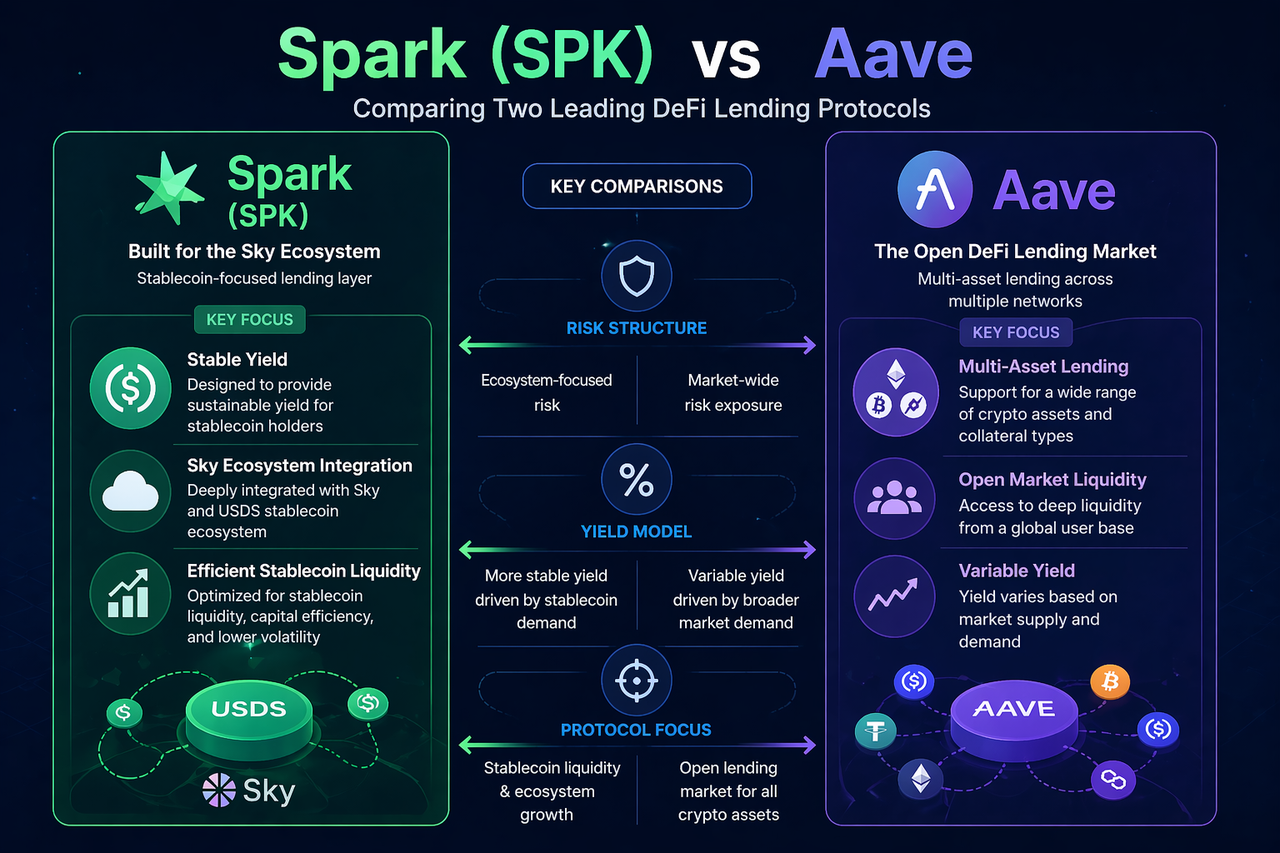
The most significant distinction between Spark and Aave is their protocol positioning.
Aave is an open lending protocol serving the entire DeFi market, supporting lending for a wide range of crypto assets. Its aim is to deliver universal lending services for all on-chain users, offering broad asset diversity, market openness, and a large user base.
By comparison, Spark is focused on managing stablecoin liquidity and distributing yield within the Sky ecosystem. Rather than building an open lending marketplace, Spark’s primary goal is to create a stablecoin-centric yield loop to maximize internal capital efficiency. In this sense, Spark acts as a dedicated yield layer for the Sky ecosystem, while Aave functions as a general-purpose lending infrastructure for DeFi as a whole.
This difference in positioning shapes their development: Aave pursues market breadth, whereas Spark emphasizes ecosystem depth.
How do the lending mechanisms of Spark and Aave differ?
Both Spark and Aave utilize a liquidity pool model. Users deposit assets into the pool, borrowers use collateral to borrow funds, and interest paid by borrowers is distributed to depositors. This mechanism enables on-chain lending without the need for direct matching.
However, their lending focus diverges. Aave supports lending for a variety of assets, including major crypto assets and stablecoins, resulting in diverse demand. Each asset market sets its own interest rates, so returns are more susceptible to market volatility.
Spark, in contrast, is designed specifically for stablecoin lending, aiming to optimize stablecoin utilization. Since lending demand is concentrated in the stablecoin market, interest rates are more stable and returns are geared toward users seeking consistent yield. As a result, Spark’s lending mechanism is ideal for those prioritizing stablecoin lending, while Aave is better for users who need flexible, multi-asset lending options.
How do Spark and Aave differ in sources of return?
Aave’s yield is primarily driven by market lending demand. When volatility and borrowing demand are high, deposit yields rise; when demand falls, yields decline. Thus, Aave’s returns are closely tied to market activity.
Spark also generates returns from borrowing interest, but its yield model relies more on stablecoin liquidity demand within the Sky ecosystem. Since Spark’s objective is to create stablecoin yield scenarios, its sources of return are more concentrated on stablecoin lending and capital efficiency, rather than on capturing yield from the broader market.
This means Aave offers higher return elasticity but with greater volatility, while Spark delivers lower elasticity but greater stability—making it a more reliable yield tool within its ecosystem.
How do Spark and Aave differ in risk structure?
Because of their distinct positioning, Spark and Aave face different risk profiles.
Aave, as an open marketplace supporting multiple assets, is mainly exposed to market volatility. In periods of high crypto market turbulence, lending demand and liquidation pressures can surge, impacting protocol returns and user asset security.
Spark, on the other hand, is more exposed to ecosystem concentration risk. Since its yield is tied to stablecoins within the Sky ecosystem, a drop in internal stablecoin demand or a depegging event could undermine Spark’s yield-generating capacity.
In summary, Aave’s risks are primarily market-driven, while Spark’s risks are ecosystem-centric. This distinction determines which protocol is better suited for users with different risk preferences.
Which users are best suited for Spark and Aave?
Users seeking to lend and borrow across multiple assets for higher potential yield will find Aave offers greater flexibility. Its open marketplace and broad asset support can accommodate a wide range of DeFi capital needs.
Conversely, users who prioritize stable returns and are optimistic about the Sky ecosystem’s growth may find Spark more appealing. Because Spark is closely linked to stablecoin yield scenarios, it is ideal for participants focused on steady returns and ecosystem growth.
From a user perspective, Aave is optimal for those seeking market flexibility, while Spark is best for users aiming to maximize stablecoin yield efficiency.
Why is Spark a key component of the Sky ecosystem?
Spark’s core value lies in more than just lending services—it creates a yield loop for the Sky ecosystem. Users deposit stablecoins to earn yield, borrowers pay interest on loans, and protocol income enhances capital flow efficiency within the ecosystem.
This mechanism increases stablecoin demand and utilization, supporting the Sky ecosystem’s capital circulation. In contrast, Aave operates as an open lending marketplace and does not serve as a closed-loop value engine for any specific ecosystem.
For the Sky ecosystem, Spark is not just a lending protocol—it is foundational infrastructure for ecosystem capital flows.
Summary
Spark and Aave are both DeFi lending protocols, but they differ significantly in positioning, sources of return, and risk structure. Aave targets the open market, focusing on multi-asset lending and liquidity, while Spark centers on stablecoin yield within the Sky ecosystem, aiming to enhance capital efficiency and build a closed-loop yield model.
For users, Aave is the go-to platform for asset diversity and market flexibility. For those who value stablecoin yield and ecosystem growth, Spark is more specialized. Understanding these distinctions helps users select the most suitable DeFi lending protocol in any market environment.
FAQs
What is the primary difference between Spark and Aave?
Spark is designed for stablecoin yield scenarios within the Sky ecosystem, while Aave is an open lending protocol for the entire DeFi market.
Do Spark and Aave have the same yield sources?
Both generate yield from borrowing interest, but Aave depends on open market demand, whereas Spark relies more on internal stablecoin demand within its ecosystem.
Is Spark’s yield more stable than Aave’s?
Generally, Spark’s yield correlates with stablecoin lending demand, but stability is not guaranteed. Aave’s yield is more strongly influenced by market demand.
Which protocol has higher risk, Spark or Aave?
Aave is more vulnerable to market volatility, while Spark’s risk is mainly tied to ecosystem concentration and changes in stablecoin demand.
Who is Spark best suited for?
Spark is best for users seeking stable returns and who are optimistic about the growth of the Sky ecosystem.







