As the global new energy vehicle market continues to grow, Tesla stands out as an industry leader, consistently drawing significant attention from the capital markets. Thanks to its strong brand presence, technological innovation, and first-mover advantage, Tesla has built a robust competitive position in the electric vehicle industry, making TSLA one of the hottest growth stocks for investors.
However, high growth potential inevitably comes with elevated risk. As more automakers enter the new energy vehicle space, Tesla is facing intensifying competitive pressure. Its high valuation also means TSLA is more sensitive to shifts in market expectations. For investors, understanding Tesla’s competitive landscape and key risk factors is essential for evaluating TSLA’s investment value.
What Competitive Pressures Does Tesla Face in the EV Market?
Tesla remains a global leader in the new energy vehicle sector, but competition is rapidly escalating. Traditional automakers are accelerating their transition to new energy, and emerging EV brands are rising quickly, making today’s competitive environment far more challenging than in Tesla’s early years.
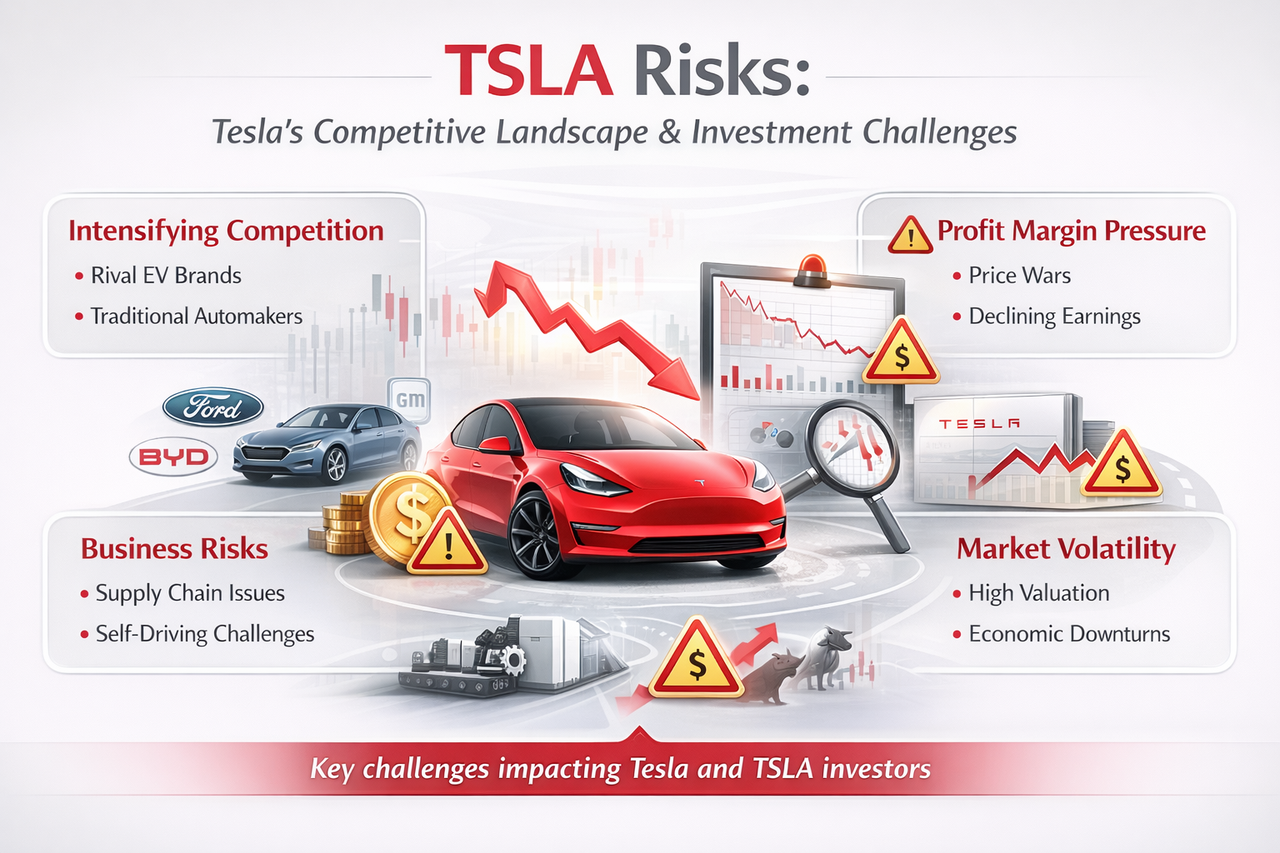
On one side, established automakers benefit from mature supply chains and expansive global sales networks, and are ramping up investments in new energy models. On the other, new EV entrants excel in smart technology and rapid local market expansion. This evolving landscape means Tesla must sustain its edge in innovation and cost efficiency to defend its market position.
As the industry matures, competition has shifted from “market education” to a battle for market share—one of Tesla’s most significant current challenges.
Who Are Tesla’s Main Rivals?
Tesla’s primary competitors fall into two categories: traditional automakers and new energy vehicle companies. Among these, BYD stands out as a major global competitor, with clear strengths in both sales volume and cost management.
Legacy automakers like Ford and General Motors are also rapidly expanding their EV portfolios, leveraging established brands and distribution channels to capture market share. Meanwhile, new players such as NIO are gaining traction in the premium EV segment.
These competitors exert pressure on Tesla across different markets and product segments, compelling the company to continually refine its product and pricing strategies to sustain growth.
How Does Price Competition Impact Tesla’s Profitability?
Price competition is a critical factor affecting Tesla’s profitability. To maintain its market share, Tesla has implemented price cuts in certain regions, aiming to boost competitiveness and drive sales.
While price reductions can increase sales volume, they also squeeze profit margins. If price adjustments are too aggressive, Tesla’s automotive profit margins may decline, negatively impacting overall profitability. Given the capital market’s high expectations for Tesla’s growth and margins, pressure on profits from price competition can erode investor confidence.
In an increasingly competitive EV industry, Tesla must strike a careful balance between expanding market share and preserving profitability—a key risk for investors to monitor.
What Business Risks Does Tesla Face?
Beyond competitive pressures, Tesla faces multiple business risks. Supply chain risks—such as volatility in battery raw material prices and supply disruptions—can impact production costs and delivery capabilities.
There is also technology execution risk. Tesla’s autonomous driving platform is seen as a major growth driver, but progress depends on technological maturity and regulatory approval. Delays or setbacks could prompt the market to downgrade long-term growth expectations.
Additionally, global demand fluctuations may affect Tesla’s operating results. If growth in EV market demand slows, Tesla’s revenue expansion could be constrained. These business risks directly impact the company’s profitability and valuation.
What Market Risks Affect TSLA Stock?
TSLA is subject to significant market risks, primarily from valuation swings and shifts in market sentiment. As a high-growth stock, Tesla typically trades at a premium to legacy automakers, reflecting lofty expectations for future performance.
If Tesla’s results fall short or the macro environment deteriorates—reducing risk appetite—TSLA could experience sharp price volatility. Growth stocks, in particular, face valuation pressure in high-interest-rate environments, directly affecting TSLA’s market performance.
Market sentiment changes can further amplify price swings. Even without changes to fundamentals, shifts in investor expectations can lead to dramatic moves, making TSLA a notably volatile investment.
Does Tesla Still Have a Sustainable Competitive Advantage?
Despite mounting competition, Tesla retains several long-term competitive advantages. The Tesla brand remains a market leader and a flagship for the new energy vehicle sector, ensuring strong consumer recognition.
Tesla also holds early-mover advantages in autonomous driving, battery technology, and charging infrastructure, reinforcing its competitive moat. Its global manufacturing footprint and economies of scale further support cost management.
However, the durability of these advantages hinges on Tesla’s ability to keep innovating and respond to competitive threats. While Tesla’s long-term advantages are real, they are not guaranteed.
What Key Metrics Should Investors Track When Considering TSLA?
Investors should closely monitor Tesla’s operational and market data to gauge growth potential and risk exposure.
Key metrics include:
These indicators reflect Tesla’s competitiveness and profitability, serving as core benchmarks for evaluating TSLA’s investment value. Significant deterioration in these metrics could put downward pressure on the stock.
Summary
TSLA offers long-term growth potential, but investors should not underestimate the associated risks. Escalating industry competition, price wars, execution challenges, and valuation volatility can all impact Tesla’s profitability and share price.
Understanding Tesla’s competitive landscape and key risk factors enables investors to more objectively assess TSLA’s investment value. Only with a clear grasp of both growth drivers and potential risks can investors make sound, well-informed decisions.
FAQs
What are TSLA’s main risks?
Key risks include intensifying industry competition, margin pressure from price wars, slower-than-expected business growth, and valuation volatility.
Who is Tesla’s top competitor?
BYD is currently one of Tesla’s primary global competitors, alongside Ford, GM, and NIO.
What risks are associated with Tesla’s high valuation?
A high valuation signals elevated market expectations for Tesla’s growth. If results disappoint, the stock could experience significant volatility.
What data should investors focus on when considering TSLA?
Investors should track delivery volumes, gross margins, market share, revenue growth, and progress in autonomous driving.