As the crypto industry has evolved, exchanges and infrastructure platforms have commonly used token models to support user incentives, governance participation, and value capture. For example, many platforms use tokens to offer trading fee discounts, ecosystem rewards, or governance voting rights.
The design of the Backpack token attempts to introduce additional mechanisms beyond these traditional functions. These include a user-first distribution structure and a release model tied to the platform’s development stages. The objective of this token model is to reduce large early allocations to investors and team members while strengthening community participation within the ecosystem.
In addition to typical functions such as network payments, trading fee discounts, and governance voting, the Backpack token is also designed as a long-term incentive mechanism. By linking token release schedules to platform development milestones, the model aims to align community participation with the growth of the ecosystem.
What Is the Backpack Token?
Issued within the Backpack ecosystem, the Backpack token operates on the Solana blockchain with a total supply of 1 billion tokens. The asset supports incentive alignment across Backpack’s trading platform, non-custodial wallet, and NFT community.
Within the ecosystem, the token enables functions such as trading fee reductions, ecosystem participation rewards, and governance activities. These roles help coordinate incentives between users and the platform’s services.
To address common challenges in crypto token design, Backpack adjusts its allocation and release structure to limit concentrated holdings by teams or early investors. Greater emphasis is placed on community participation and ecosystem engagement.
Under this structure, the token extends beyond basic platform payments or discounts and also functions as a mechanism connecting community participation with the long-term development of the Backpack ecosystem.
Backpack Tokenomics: Supply and Distribution Structure
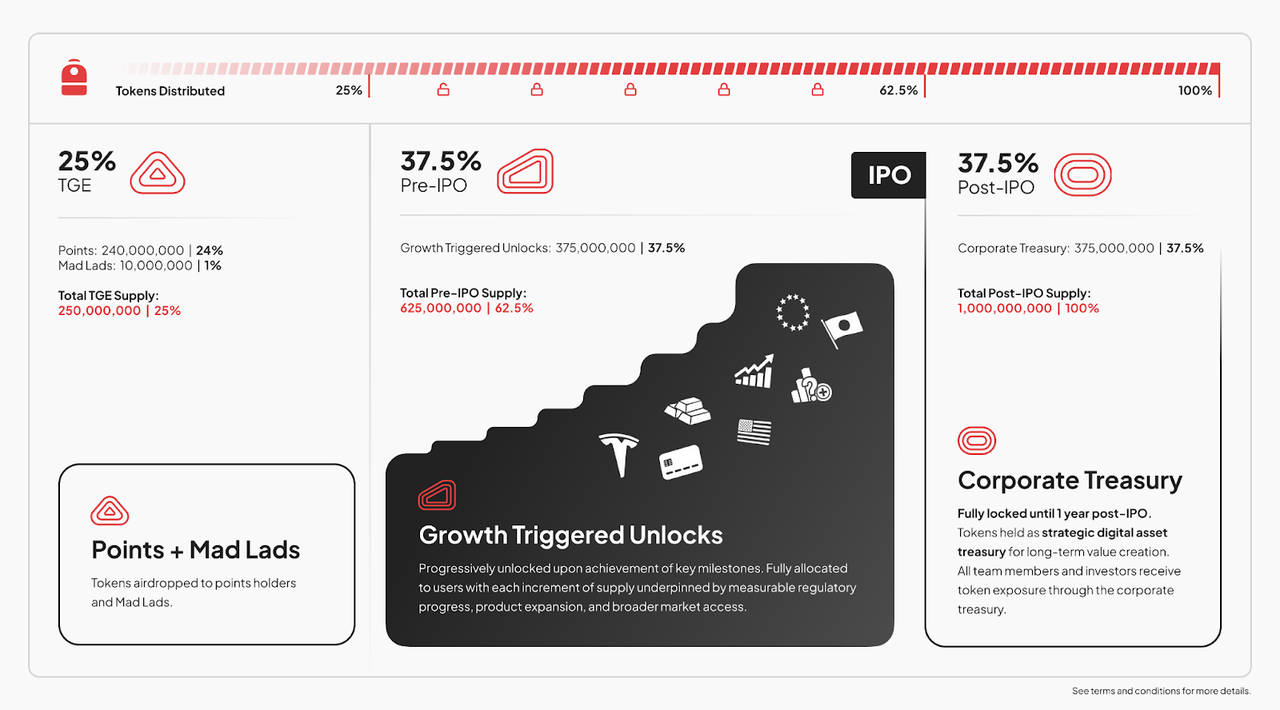
Token issuance and release follow three primary phases. The growth of circulating supply is designed to progress alongside the development of the Backpack platform.
Initial Phase: TGE (Token Generation Event)
During the Token Generation Event phase, 25% of the total supply (250 million tokens) enters circulation and is primarily allocated to community participants.
| Allocation Category |
Amount |
Share |
| Points holders |
240 million |
24% |
| Mad Lads NFT holders |
10 million |
1% |
| Team / VC |
0 |
0% |
The design of this phase emphasizes community participation while providing initial market liquidity.
In addition, the project has indicated that token staking participants may become eligible in the future for a potential equity conversion opportunity involving up to 20% of the company’s shares.
Mid-Term Phase: Pre-IPO Growth Stage
During the platform’s development stage, 37.5% of the total supply (375 million tokens) may gradually be distributed through ecosystem incentives and airdrops.
Token releases in this stage are not based on a fixed time schedule. Instead, distribution is linked to platform development milestones such as obtaining regulatory licenses, expanding into new markets, or launching key product features.
Through this approach, additional token supply is intended to maintain a connection with the platform’s growth and progress.
By the end of the Pre-IPO stage, approximately 62.5% of tokens are expected to be distributed to community participants.
Long-Term Phase: Post-IPO Maturity Stage
The remaining 37.5% of the total supply (375 million tokens) is planned to be held in the company treasury and locked for at least one year after a potential IPO.
These tokens are intended for long-term strategic purposes, including ecosystem development, partnership incentives, and operational support. Participation from team members and investors generally occurs through company equity rather than direct early-stage token allocations.
Key Features and Distinctive Mechanisms of the Backpack Token
Several design elements distinguish the Backpack token model from many conventional platform tokens.
User First Distribution Model
Across the TGE and Pre-IPO phases, up to 62.5% of the token supply is theoretically allocated to community participants. During the early stages, team members and investment institutions do not receive direct token allocations. This structure aims to strengthen community participation and align ecosystem growth with user engagement.
Milestone Driven Token Release
Instead of relying on a linear time based unlocking schedule, token distribution follows the platform’s development stages. Examples include regulatory progress, market expansion, or the launch of major product features. Linking token release to these milestones attempts to keep supply growth connected with ecosystem development.
Potential Equity Bridging Mechanism
Backpack has introduced a mechanism that links token staking with potential equity participation. Through staking, users may become eligible to exchange tokens for a portion of the company’s shares in the future. The project has indicated that this mechanism could involve up to 20% of the company’s equity, exploring a possible connection between digital asset participation and traditional financial ownership structures.
Use Cases and Applications of the Backpack Token
Utility within the Backpack ecosystem continues to expand alongside its product lines.
-
Trading and Fees
-
On the Backpack exchange, holding and staking the Backpack token may provide trading fee discounts, helping reduce transaction costs.
-
Governance and Incentives
-
Token holders may participate in governance decisions that influence ecosystem development. The token may also be used to incentivize activities such as liquidity provision, ecosystem tasks, or participation in NFT related events.
-
Value Anchoring and Equity Conversion
-
A long term application concept involves using the token as a credential for potential equity conversion in the Backpack parent company. This approach attempts to connect Web3 governance tokens with traditional corporate ownership structures.
-
Future Ecosystem Expansion
-
As Backpack expands into areas such as lending, derivatives trading, and cross chain infrastructure, the token may function as a core asset across these products, supporting payments, staking, and collateral use cases.
Backpack Token vs Gate Token
Compared with the exchange tokens of Binance and Gate, the design of the Backpack token differs from BNB and GT in several aspects.
| Project |
Token Characteristics |
| BNB |
Platform utility such as trading fee discounts; periodic buyback and burn; circulation within the BNB Chain ecosystem |
| GT |
Platform utility including fee deductions, Launchpad, Launchpool, HODLer Airdrop, and CandyDrop; buyback and burn mechanisms; circulation within the GateChain ecosystem |
| Backpack Token |
User first distribution model combined with a potential equity bridging mechanism |
A key distinction lies in the introduction of a mechanism similar to long term equity incentives within a platform token model. This structure attempts to align token participation with the platform’s broader growth trajectory.
Potential Risks of the Backpack Token
Despite the innovative aspects of the Backpack token model, several uncertainties may influence its long-term outcomes.
Uncertainty Around the IPO Path
A significant part of the token’s value narrative is linked to the possibility of a future IPO. Market conditions, regulatory developments, or internal business factors could delay or even prevent such a listing. Any uncertainty surrounding the IPO timeline may affect long-term market expectations for the token.
Regulatory Compliance Risks
Linking a token mechanism with potential equity conversion remains relatively uncommon globally. Such a structure could face complex interpretations under securities regulations. Differences in how jurisdictions classify or regulate these mechanisms may influence the token’s accessibility and potential value.
Liquidity and Dilution Risks
If equity conversion requires extended staking periods, token holders may face reduced liquidity during lock-up periods. At the same time, although Pre-IPO token releases are tied to platform milestones, the gradual increase in circulating supply could still introduce dilution pressure in the short term, particularly if ecosystem growth progresses more slowly than expected.
Backpack operates as an emerging regulated trading platform in a highly competitive market. Challenges related to user growth, product development, and competition may influence the platform’s overall progress. If core business expansion does not meet expectations, demand for the Backpack token and its ability to capture value could be affected.
Conclusion
The Backpack tokenomics model introduces several new incentive mechanisms within the crypto ecosystem. Through a user-first distribution structure, milestone-driven token releases, and a potential equity bridging concept, the model explores ways to connect Web3 participation with traditional financial value frameworks.
This approach expands the role of platform tokens beyond simple trading discounts, enabling them to support ecosystem governance, user incentives, and long-term value alignment. As the Backpack ecosystem continues to evolve, the practical impact of this token model will depend on how the platform develops over time and how the market responds to its structure.
FAQs
When Will the Backpack TGE Take Place?
On March 11, 2026, Backpack CEO Armani Ferrante indicated that the token generation event is expected to occur around March 23. The exact launch date remains subject to official confirmation.
What Is the Total Supply of the Backpack Token?
The total supply is set at 1 billion tokens, and the project has stated that there are currently no plans to increase the supply.
Do the Team or Venture Capital Investors Receive Tokens During the TGE Phase?
According to official disclosures, the 250 million tokens released during the TGE phase are allocated entirely to community users. Team members and venture capital investors do not receive token allocations during this stage.
How Does Backpack’s Token-to-Equity Mechanism Work?
Through a staking mechanism, participants may become eligible to exchange Backpack tokens for a portion of the company’s equity in the future. The project has indicated that this mechanism could involve up to 20% of the company’s equity.
How Are Tokens Released During the Pre-IPO Stage?
Token distribution during the Pre-IPO stage follows platform development milestones rather than a fixed time-based schedule. Examples include regulatory approvals, market expansion, or the launch of key product features.