As Proof of Stake (PoS) continues to become the dominant consensus mechanism, staking in blockchain networks has evolved from a simple security function into a foundational source of yield. The emergence of liquid staking (LSD) and yield-generating derivative strategies allows users to earn returns while maintaining liquidity, further accelerating the growth of the DeFi ecosystem.
Within this evolution, StakeStone is increasingly seen as a key piece of infrastructure connecting liquid staking with restaking. By introducing yield aggregation and cross-chain allocation mechanisms, StakeStone not only expands the sources of staking returns but also improves capital efficiency across multiple chains, positioning itself as an important player in both the LSDfi and restaking sectors.
What Is StakeStone? Origins and Background
StakeStone is a yield aggregation protocol designed to unify liquid staking assets, such as ETH and its derivatives, with restaking mechanisms. Through a coordinated strategy layer, it enhances the overall efficiency of asset returns. Its core objective is to consolidate fragmented yield opportunities across different protocols and chains into a single, automated system.
Its emergence is closely tied to two major trends. First, the widespread adoption of liquid staking has made staked assets liquid. Second, the rise of restaking enables the same asset to participate in multiple yield streams. Building on these trends, StakeStone introduces cross-chain capabilities to extend yield optimization across a multi-chain environment.

What Is StakeStone’s Core Architecture?
StakeStone’s architecture can be understood as a multi-layer yield management framework, consisting of three main layers: the asset layer, the strategy layer, and the cross-chain layer.
At the asset layer, users deposit ETH or liquid staking tokens (LSTs), which serve as the base for generating returns. At the strategy layer, the protocol allocates these assets across various yield strategies, including both native staking and restaking, to create compounded returns. At the cross-chain layer, StakeStone uses cross-chain communication or bridging mechanisms to deploy capital across different networks in search of higher yields.
The core idea behind this architecture is unified management with dynamic allocation. Users do not need to manually execute complex strategies, yet they can still gain exposure to multiple yield sources.
How Does StakeStone Work?
StakeStone operates as a continuous, automated yield cycle.
First, users deposit ETH or related LSTs into the protocol, forming a unified liquidity pool. In return, the protocol issues a receipt token, such as STONE, representing the user’s share. This token can be used across DeFi applications while reflecting the user’s underlying position.
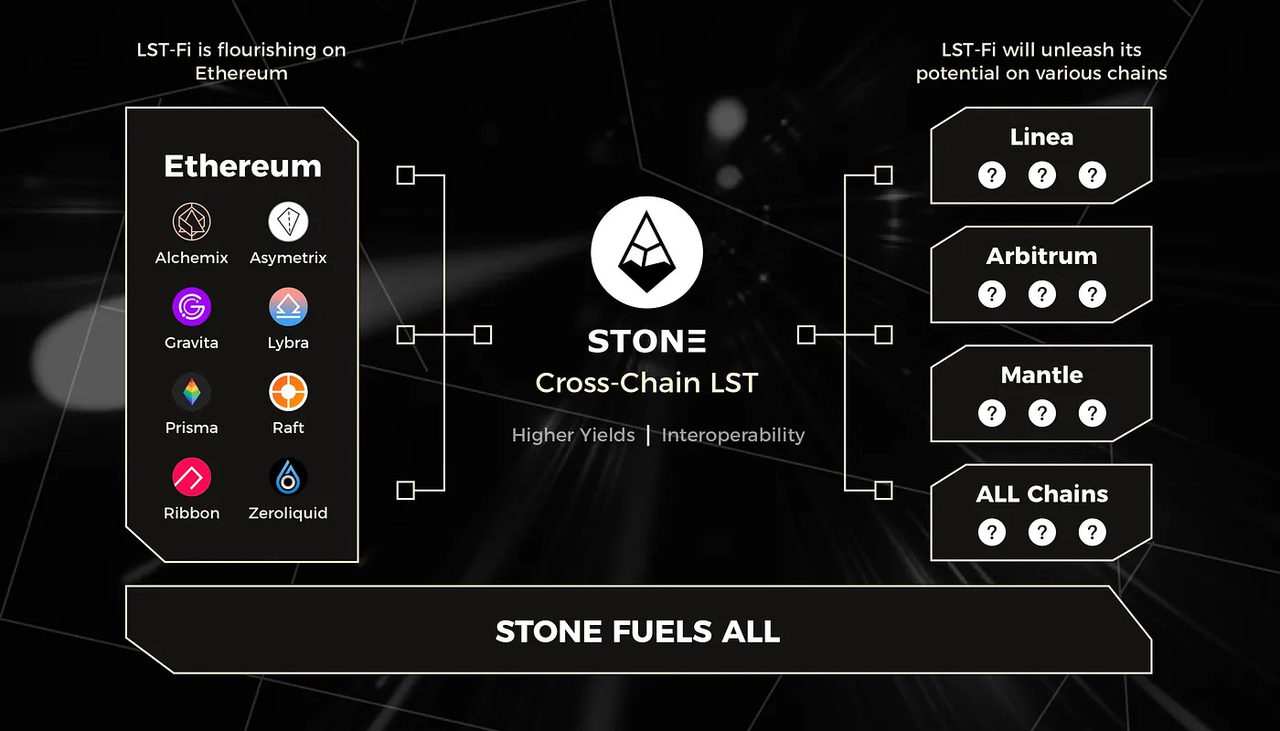
Next, the protocol allocates assets according to predefined strategies, distributing funds between base staking and restaking mechanisms to capture different yield sources. Some capital may also be deployed across chains to access cross-chain opportunities. Over time, rewards accumulate and are reflected in the value of the receipt token, creating an automated yield growth process.
StakeStone’s Restaking Mechanism
Restaking is one of the key mechanisms StakeStone uses to enhance returns. Its core idea is to allow already staked assets to be reused across multiple contexts.
In traditional staking, assets are used to secure a single blockchain network. With restaking, those same assets can be allocated to additional protocols, such as providing validation services or security, thereby generating extra yield. This significantly improves capital efficiency.
However, restaking also introduces a more complex risk structure, including multi-protocol dependencies, potential slashing risks, and increased system complexity. As a result, higher returns often come with higher risks.
StakeStone’s Tokenomics and Incentive Model
StakeStone typically involves two key types of tokens. One is the receipt token representing user deposits, such as STONE, and the other is the protocol-level token, STO.
STONE functions at the asset layer, representing deposited funds and their accrued yield. STO operates at the protocol layer, supporting governance, incentives, and ecosystem development. This layered design separates asset ownership from protocol control.
From an incentive perspective, STO is used to reward liquidity provision, protocol participation, and ecosystem contributions. It also enables governance, allowing holders to vote on parameter adjustments and protocol upgrades, contributing to decentralized management.
Use Cases and Role in the StakeStone Ecosystem
StakeStone plays a dual role in the DeFi ecosystem, focusing on yield optimization and liquidity management.
On one hand, its aggregation capability makes it a foundational component in DeFi yield strategies, enabling users to access multiple income streams without manual intervention. On the other hand, its cross-chain functionality allows capital to move across networks, improving overall capital efficiency.
Additionally, StakeStone acts as a connector within the LSDfi and restaking ecosystems, integrating liquid staking assets with restaking protocols and facilitating coordination across multiple systems.
StakeStone vs EigenLayer vs Lido: Key Differences
StakeStone, EigenLayer, and Lido all revolve around staking assets, but they differ significantly in positioning and functionality.
Lido focuses on providing liquid staking services, allowing users to receive liquid assets while staking ETH. EigenLayer specializes in restaking, enabling assets to secure additional services. StakeStone, by contrast, integrates both capabilities and further enhances them through yield aggregation and cross-chain allocation.
Structurally, Lido can be viewed as the asset generation layer, EigenLayer as the reuse layer, and StakeStone as the strategy and orchestration layer, optimizing resource allocation and returns across multiple protocols.
Advantages and Potential Risks of StakeStone
StakeStone’s main advantage lies in its ability to combine multiple yield sources with cross-chain functionality, improving capital efficiency while lowering the barrier to complex strategies. Its automated system also makes yield management more efficient.
At the same time, its risks should not be overlooked. The involvement of multiple protocols and cross-chain operations increases system complexity, which may introduce smart contract and bridging risks. Additionally, restaking can bring added slashing risks, making the overall risk structure more layered.
Conclusion
By integrating liquid staking, restaking, and cross-chain mechanisms, StakeStone builds a multi-layer yield management system that allows users to access diverse income streams while maintaining liquidity. Its core value lies in improving capital efficiency and simplifying user participation, though this comes with increased structural complexity and risk.
As a key piece of infrastructure in LSDfi and restaking landscape, StakeStone reflects a broader shift in blockchain yield models, from single-source returns to more complex, multi-dimensional strategies.
FAQs
What is the difference between StakeStone and Lido?
Lido provides liquid staking assets, while StakeStone focuses on aggregating yield strategies and enabling cross-chain allocation.
Is StakeStone a restaking protocol?
StakeStone is not purely a restaking protocol; it is a yield aggregation system that incorporates restaking capabilities.
What is the difference between STO and STONE?
STONE represents user asset shares, while STO is used for governance and incentives.
What are the sources of StakeStone’s yield?
Its yield mainly comes from a combination of base staking rewards and restaking returns.
Does StakeStone support multiple chains?
Yes, StakeStone includes a cross-chain yield orchestration mechanism by design.







