


CRV vs DOGE: A Comprehensive Comparison of Two Major Cryptocurrency Tokens in 2024

Introduction: CRV vs DOGE Investment Comparison
In the cryptocurrency market, the comparison between Curve (CRV) and Dogecoin (DOGE) has always been a topic that investors cannot avoid. The two not only show significant differences in market cap ranking, application scenarios, and price performance, but also represent different positioning of crypto assets.
Curve (CRV): Since its launch in January 2020, it has gained market recognition by providing extremely efficient and low-cost stable coin trading on Ethereum through its decentralized liquidity pool exchange mechanism.
Dogecoin (DOGE): Since its inception on December 8, 2013, it has been envisioned as a fun and lighthearted cryptocurrency, evolving into the second-largest virtual currency by user base after Bitcoin.
This article will comprehensively analyze the investment value comparison between CRV and DOGE from the perspectives of historical price trends, supply mechanisms, market positioning, and ecosystem characteristics, while attempting to answer the question that investors care about most:
"Which is the better buy right now?"
Comparative Analysis of Curve (CRV) and Dogecoin (DOGE) as of December 16, 2025
I. Historical Price Comparison and Current Market Status
Historical Price Trajectories of CRV and DOGE
Curve (CRV):
- Launched in January 2020 at an initial price of $13.00
- Reached an all-time high of $15.37 on August 14, 2020
- Declined to an all-time low of $0.180354 on August 5, 2024
- Over the past year, the token has experienced a decline of 68.84%
Dogecoin (DOGE):
- Created on December 8, 2013, based on the Scrypt algorithm
- Reached an all-time high of $0.731578 on May 8, 2021
- Fell to an all-time low of $0.0000869 on May 6, 2015
- Over the past year, the token has declined 68.25%
Comparative Analysis: Both tokens have experienced significant long-term declines. CRV has fallen approximately 97.7% from its peak, while DOGE has declined approximately 99.98% from its historical high. However, both assets demonstrate comparable year-over-year performance losses (CRV: -68.84% vs DOGE: -68.25%), suggesting exposure to similar broad market headwinds affecting the cryptocurrency sector.
Current Market Status (December 16, 2025)
CRV Current Metrics:
- Price: $0.3524
- 24-hour change: -7.91%
- 7-day change: -9.21%
- 30-day change: -18.04%
- Market capitalization: $506,093,075
- Fully diluted valuation: $821,984,367
- 24-hour trading volume: $1,644,871
- Circulating supply: 1,436,132,449 CRV
- Market ranking: #117
DOGE Current Metrics:
- Price: $0.12925
- 24-hour change: -5.62%
- 7-day change: -8.24%
- 30-day change: -20.14%
- Market capitalization: $21,698,309,454
- Fully diluted valuation: $21,702,560,487
- 24-hour trading volume: $21,925,472
- Circulating supply: 167,878,603,126 DOGE
- Market ranking: #11
Market Sentiment:
- Crypto Fear & Greed Index: 11 (Extreme Fear)
The market sentiment indicates heightened fear among investors, with both assets trading in a bearish environment. CRV is experiencing steeper short-term declines compared to DOGE across most timeframes, though both tokens reflect broader cryptocurrency market weakness.
Real-time Price References:
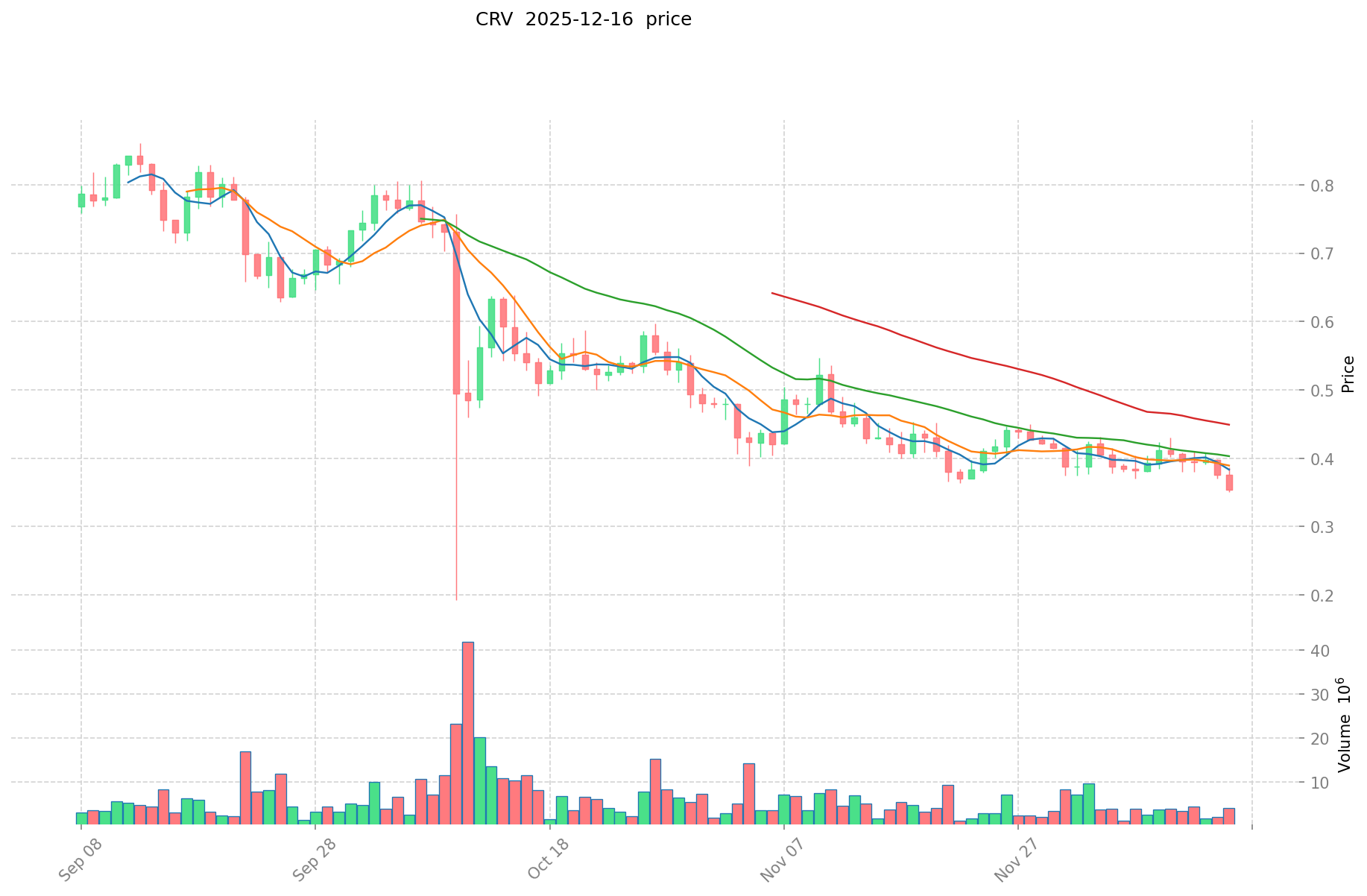

Comparative Analysis of CRV and DOGE Investment Value in the Current Market Environment
II. Core Factors Influencing CRV vs DOGE Investment Value
Supply Mechanism Comparison (Tokenomics)
-
CRV: Maximum supply of 3,030,303,031 tokens. Supply mechanism directly impacts price and investment value. Historical supply changes have driven CRV price movements.
-
DOGE: Operates under market demand and community support dynamics. Historical price performance reflects meme coin category characteristics with strong market appeal.
-
📌 Historical Pattern: Supply scarcity mechanisms influence price cycle variations. CRV's fixed maximum supply creates defined scarcity parameters, while DOGE's market dynamics are primarily driven by community sentiment and adoption.
Institutional Adoption and Market Application
-
Institutional Holdings: CRV demonstrates stronger institutional appeal through its governance and incentive token structure within the Curve Finance ecosystem. DOGE's institutional adoption remains limited due to its meme coin classification.
-
Enterprise Adoption: CRV serves as the governance token for Curve Finance, enabling stablecoin trading and liquidity provision in decentralized finance. The protocol maintains a dominant market position in stablecoin exchange markets. DOGE remains primarily oriented toward retail adoption and community-driven use cases.
-
Regulatory Environment: CRV operates within the DeFi governance framework with varying regulatory approaches across jurisdictions. DOGE faces similar regulatory uncertainty as other cryptocurrency assets, with treatment varying by country.
Technology Development and Ecosystem Construction
-
CRV Ecosystem: Curve Finance emphasizes decentralization and democratization of liquidity provision. The platform employs innovative algorithms optimizing token swaps with similar values. Core value capture depends substantially on the voting escrow model (veCRV), fee distribution mechanisms (denominated in crvUSD), and maintaining stablecoin exchange depth.
-
DOGE Ecosystem: Operates as a meme coin within its category, combining humor with market appeal. Ecosystem development remains limited compared to utility-focused tokens.
-
Ecological Comparison: CRV demonstrates active DeFi integration as a governance and incentive token within stablecoin and liquidity aggregation platforms. DOGE operates primarily outside structured DeFi applications, maintaining its position as a community-driven asset.
Macroeconomic Factors and Market Cycles
-
Performance in Inflationary Environments: CRV's value proposition is rooted in DeFi protocol utility rather than inflation hedging properties. DOGE similarly lacks traditional inflation-hedging characteristics, with value driven by market sentiment.
-
Monetary Policy Impact: Interest rate changes and USD index movements affect both assets through broader cryptocurrency market dynamics. CRV's connection to DeFi activity may respond differently to monetary policy shifts compared to DOGE's sentiment-driven valuation.
-
Geopolitical Considerations: Cross-border transaction demand supports stablecoin utility and consequently CRV's ecosystem value. DOGE's geopolitical relevance remains minimal, with adoption driven primarily by retail communities.
Disclaimer: This analysis is based on available reference materials and does not constitute investment advice. Investors should conduct independent research and consult qualified financial advisors before making investment decisions.
III. 2025-2030 Price Prediction: CRV vs DOGE
Short-term Prediction (2025)
- CRV: Conservative $0.2992 - $0.352 | Optimistic $0.41536
- DOGE: Conservative $0.0671996 - $0.12923 | Optimistic $0.1860912
Mid-term Prediction (2027-2028)
- CRV may enter a growth consolidation phase, with predicted price range of $0.373589216 - $0.59963121856
- DOGE may enter an accumulation phase, with predicted price range of $0.13040896529 - $0.264675097159
- Key drivers: Institutional capital inflows, ETF developments, ecosystem expansion and DeFi adoption
Long-term Prediction (2029-2030)
- CRV: Base scenario $0.3350775048192 - $0.602092391472 | Optimistic scenario $0.72853179368112
- DOGE: Base scenario $0.17268534774183 - $0.249693678491565 | Optimistic scenario $0.312117098114456
Disclaimer
This analysis is based on historical data and predictive models only. Cryptocurrency markets are highly volatile and unpredictable. These forecasts do not constitute investment advice. Past performance does not guarantee future results. Please conduct thorough research and consult financial professionals before making investment decisions.
CRV:
| 年份 | 预测最高价 | 预测平均价格 | 预测最低价 | 涨跌幅 |
|---|---|---|---|---|
| 2025 | 0.41536 | 0.352 | 0.2992 | 0 |
| 2026 | 0.4373952 | 0.38368 | 0.2570656 | 8 |
| 2027 | 0.484434368 | 0.4105376 | 0.373589216 | 16 |
| 2028 | 0.59963121856 | 0.447485984 | 0.3803630864 | 26 |
| 2029 | 0.680626181664 | 0.52355860128 | 0.3350775048192 | 48 |
| 2030 | 0.72853179368112 | 0.602092391472 | 0.5719877718984 | 70 |
DOGE:
| 年份 | 预测最高价 | 预测平均价格 | 预测最低价 | 涨跌幅 |
|---|---|---|---|---|
| 2025 | 0.1860912 | 0.12923 | 0.0671996 | 0 |
| 2026 | 0.209688598 | 0.1576606 | 0.122975268 | 21 |
| 2027 | 0.2204095188 | 0.183674599 | 0.13040896529 | 42 |
| 2028 | 0.264675097159 | 0.2020420589 | 0.18183785301 | 56 |
| 2029 | 0.26602877895363 | 0.2333585780295 | 0.17268534774183 | 80 |
| 2030 | 0.312117098114456 | 0.249693678491565 | 0.214736563502745 | 93 |
Comparative Analysis of Curve (CRV) and Dogecoin (DOGE) as Investment Options
IV. Investment Strategy Comparison: CRV vs DOGE
Long-term vs Short-term Investment Strategy
-
CRV: Suited for investors focused on DeFi ecosystem potential and governance participation. Long-term strategy emphasizes veCRV staking mechanisms and fee distribution benefits. Short-term strategy requires monitoring stablecoin market activity and liquidity depth on Curve Finance.
-
DOGE: Suited for investors seeking retail community-driven appreciation and sentiment-based trading opportunities. Long-term strategy relies on sustained community engagement and adoption trends. Short-term strategy capitalizes on volatile price swings driven by market sentiment and social media momentum.
Risk Management and Asset Allocation
-
Conservative Investors: CRV 35% vs DOGE 65% (DOGE allocation reflects larger market cap and more established retail base, though both carry significant volatility risk)
-
Aggressive Investors: CRV 60% vs DOGE 40% (Higher CRV allocation captures DeFi governance upside potential; DOGE exposure remains for sentiment-driven volatility plays)
-
Hedging Instruments: Stablecoin positioning (USDC/USDT) for downside protection, cross-exchange arbitrage opportunities between CRV and DOGE pairs, diversification through Bitcoin and Ethereum core holdings
V. Potential Risk Comparison
Market Risk
-
CRV: Concentrated risk in DeFi protocol adoption and stablecoin market demand. Regulatory actions targeting DeFi governance tokens could significantly impact valuation. Historical price decline of 97.7% from peak indicates substantial liquidity risk and potential washout scenarios.
-
DOGE: Valuation driven primarily by retail sentiment and social media trends, creating elevated bubble risk. Limited fundamental utility outside community engagement creates susceptibility to sharp reversals. Market cap concentration among early holders presents potential dumping scenarios.
Technology Risk
-
CRV: Ecosystem reliance on Ethereum network security and scaling solutions. Smart contract vulnerabilities within governance mechanisms could impact token security. Algorithm efficiency depends on continuous optimization for stablecoin pair trading.
-
DOGE: Scrypt algorithm utilization limits mining decentralization compared to SHA-256. Network security dependent on smaller hash rate than Bitcoin, creating theoretical vulnerability to 51% attacks. Development velocity remains lower compared to actively maintained blockchain projects.
Regulatory Risk
-
CRV: DeFi governance tokens face increasing regulatory scrutiny regarding securities classification. Stablecoin regulation in key jurisdictions (EU, US) directly impacts Curve Finance ecosystem utility and consequently CRV value. Global enforcement actions targeting DeFi platforms create operational uncertainty.
-
DOGE: Classified as commodity in most jurisdictions, reducing direct securities regulation exposure. However, exchange listing regulations and stablecoin-adjacent restrictions may impact trading access. Cross-border transaction limitations through regulatory frameworks affect retail adoption potential.
VI. Conclusion: Which Is the Better Buy?
Investment Value Summary:
-
CRV Strengths: Governance token within established DeFi protocol capturing stablecoin trading value. Voting escrow model provides stakeholder participation benefits. Fee distribution mechanisms through crvUSD create ongoing value capture for token holders. Institutional DeFi adoption trends favor utility-driven tokens.
-
DOGE Strengths: Established market position as second-largest cryptocurrency by user base. Lower technical barriers to entry for retail investors. Community-driven development maintains engagement across global markets. Proven resilience through market cycles since 2013 inception.
Investment Recommendations:
-
Beginner Investors: DOGE recommended for established market presence, lower entry complexity, and community-driven support infrastructure. Higher liquidity and trading volume reduce execution risk. CRV requires deeper understanding of DeFi mechanisms and governance structures.
-
Experienced Investors: CRV allocation emphasizes DeFi ecosystem alpha capture and governance participation. Consideration of veCRV staking strategies and fee optimization enhances risk-adjusted returns. DOGE suitable for tactical sentiment-based position sizing and volatility harvesting.
-
Institutional Investors: CRV demonstrates stronger institutional appeal through governance framework and DeFi protocol integration. Curve Finance ecosystem maturity supports larger position sizing. DOGE liquidity depth and market cap ($21.7B) accommodate significant capital deployment, though utility-focused thesis remains limited.
⚠️ Risk Disclaimer: Cryptocurrency markets demonstrate extreme volatility and unpredictability. Both CRV and DOGE have experienced significant historical declines (CRV: -97.7%, DOGE: -99.98% from peaks). Current market sentiment registers at Extreme Fear levels (Crypto Fear & Greed Index: 11), indicating heightened risk conditions. This analysis does not constitute investment advice. Investors must conduct independent research, assess personal risk tolerance, and consult qualified financial professionals before making investment decisions. Past performance does not guarantee future results. None
Frequently Asked Questions: CRV vs DOGE Investment Comparison
I. FAQ
Q1: What are the key differences in market positioning between CRV and DOGE as of December 2025?
A: CRV operates as a governance token within the Curve Finance DeFi ecosystem, focusing on stablecoin trading and liquidity provision with a market cap of $506 million (ranked #117). DOGE functions as a community-driven meme coin with significantly larger market dominance at $21.7 billion (ranked #11). CRV appeals to institutional and DeFi-focused investors, while DOGE maintains strong retail adoption and broader user base recognition.
Q2: How do the supply mechanisms of CRV and DOGE influence their investment value?
A: CRV operates under a fixed maximum supply of 3.03 billion tokens, creating defined scarcity parameters that directly impact price cycles. DOGE lacks a maximum supply cap and operates under market demand dynamics driven primarily by community sentiment. CRV's supply constraints create stronger scarcity mechanics, while DOGE's unlimited supply model depends more heavily on adoption trends and community engagement for value support.
Q3: Which token demonstrates better short-term price stability?
A: Both tokens show comparable year-over-year performance declines (CRV: -68.84% vs DOGE: -68.25%), but CRV exhibits steeper short-term volatility with a 24-hour decline of -7.91% versus DOGE's -5.62%. Current market sentiment (Crypto Fear & Greed Index: 11 - Extreme Fear) affects both assets negatively, though DOGE's larger market cap and established retail base provide marginally better liquidity characteristics for stability.
Q4: What is the institutional adoption outlook for each token?
A: CRV demonstrates substantially stronger institutional appeal through its structured governance framework (veCRV), fee distribution mechanisms, and DeFi protocol integration. Curve Finance maintains a dominant position in stablecoin exchange markets, attracting institutional liquidity providers. DOGE faces limited institutional adoption due to meme coin classification and minimal utility-focused applications, remaining primarily oriented toward retail communities and sentiment-driven investment.
Q5: What are the primary risk factors differentiating CRV and DOGE investments?
A: CRV faces concentrated DeFi protocol adoption risk, regulatory uncertainty regarding governance tokens, and smart contract vulnerability exposure. DOGE confronts elevated bubble risk from retail sentiment dependency, weaker network security compared to Bitcoin (smaller hash rate), and valuation driven primarily by social media trends. CRV presents technology and regulatory risks, while DOGE presents market sentiment and network security risks.
Q6: How should conservative investors allocate between CRV and DOGE?
A: Conservative investors are recommended to maintain CRV allocation at 35% and DOGE allocation at 65%, recognizing DOGE's larger market cap ($21.7B), more established retail infrastructure, and greater liquidity depth. This allocation emphasizes DOGE's market stability advantages while maintaining minimal CRV exposure for DeFi ecosystem participation. Both allocations should be supplemented with stablecoin positioning (USDC/USDT) for downside protection given extreme fear market conditions.
Q7: What do price predictions suggest for CRV and DOGE through 2030?
A: CRV predictions indicate growth potential from $0.3524 (current) to $0.729 (optimistic 2030 scenario), representing approximately 107% upside under favorable DeFi adoption conditions. DOGE predictions show more conservative appreciation from $0.1293 (current) to $0.312 (optimistic 2030 scenario), approximately 141% upside driven by community engagement persistence. Both projections depend heavily on macroeconomic conditions, regulatory frameworks, and sustained ecosystem development.
Q8: Which token is more suitable for beginner investors?
A: DOGE is recommended for beginner investors due to established market presence since 2013, lower technical barriers to entry, robust community infrastructure, and higher trading liquidity ($21.9B 24-hour volume vs CRV's $1.6M). CRV requires deeper understanding of DeFi mechanisms, governance structures (veCRV), and stablecoin market dynamics, making it more suitable for experienced cryptocurrency investors. DOGE provides simpler entry point with reduced complexity for retail market participants.
Share
Content
Introduction: CRV vs DOGE Investment Comparison
I. Historical Price Comparison and Current Market Status
II. Core Factors Influencing CRV vs DOGE Investment Value
Short-term Prediction (2025)
Mid-term Prediction (2027-2028)
Long-term Prediction (2029-2030)
Disclaimer
IV. Investment Strategy Comparison: CRV vs DOGE
V. Potential Risk Comparison
VI. Conclusion: Which Is the Better Buy?
I. FAQ
How to Buy Cryptocurrency


Trending Cryptocurrencies



XZXX: A Comprehensive Guide to the BRC-20 Meme Token in 2025

Bitcoin Fear and Greed Index: Market Sentiment Analysis for 2025

Top Crypto ETFs to Watch in 2025: Navigating the Digital Asset Boom

5 ways to get Bitcoin for free in 2025: Newbie Guide
Bitcoin Market Cap in 2025: Analysis and Trends for Investors

2025 Bitcoin Price Prediction: Trump's Tariffs' Impact on BTC

Is AIOZ Network (AIOZ) a good investment?: A Comprehensive Analysis of Market Potential, Technology Innovation, and Risk Factors in 2024

Is ThetaFuel (TFUEL) a good investment? A Comprehensive Analysis of Tokenomics, Use Cases, and Market Potential in 2024

Is Qtum (QTUM) a good investment?: A Comprehensive Analysis of Features, Risks, and Market Potential

Is Alchemist AI (ALCH) a good investment?: A comprehensive analysis of price potential, market fundamentals, and risk factors for 2024-2025

Is dYdX (DYDX) a good investment?: A Comprehensive Analysis of Risk, Potential Returns, and Market Positioning in 2024
