As DeFi, on-chain derivatives, and automated financial systems evolve, blockchain's dependence on off-chain data continues to increase, making oracles the essential infrastructure bridging the on-chain and off-chain worlds.
Within this domain, Chainlink and Pyth Network stand out as the most representative solutions, each with distinct design philosophies and technical approaches.
Pyth and Chainlink: Positioning and Core Differences
The primary role of oracles is to securely deliver off-chain data—such as prices, indices, or interest rates—to blockchain smart contracts. Since blockchains cannot natively access external data, oracles serve as foundational infrastructure for DeFi, derivatives, RWA, and other applications.
Chainlink is an industry-standard, general-purpose oracle network that prioritizes security and decentralization. In contrast, Pyth Network is a high-performance data network tailored for financial markets, emphasizing low latency and high-frequency updates.
From a broader perspective, Chainlink functions as an infrastructure layer, while Pyth operates as a real-time data layer.
| Comparison Dimension |
Pyth Network |
Chainlink |
| Data Source |
Direct from first-party institutions |
Aggregated by third-party nodes |
| Update Method |
Pull (on-demand retrieval) |
Push (continuous streaming) |
| Key Advantage |
High-frequency, low latency |
Decentralized validation |
| Cost Structure |
Pay-per-use |
Ongoing update costs |
| Application Scenario |
High-frequency DeFi price data |
General-purpose oracle services |
In terms of design, Chainlink focuses on the “data validation and decentralized consensus layer,” whereas Pyth specializes in the “high-frequency financial data distribution layer.” They are not direct substitutes; each is optimized for distinct use cases.
Chainlink aggregates and verifies data from multiple independent nodes before posting it on-chain, emphasizing security and resistance to manipulation. Pyth Network, by directly connecting with exchanges and market makers as primary data providers, rapidly transmits raw market data on-chain, significantly reducing latency.
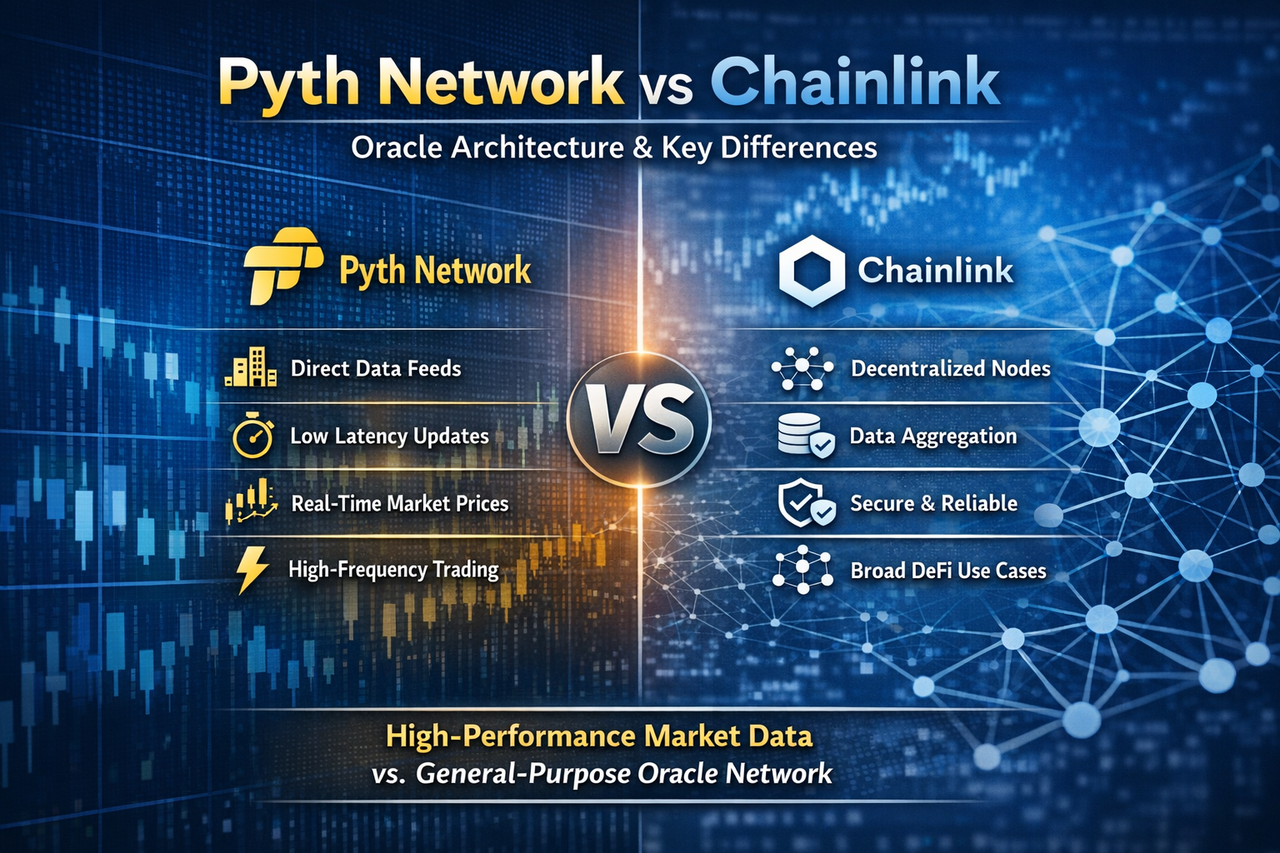
Chainlink vs Pyth Network: Architecture and Data Pathways
Architecturally, Chainlink employs a distributed, multi-node network, where each node independently collects data and participates in consensus, ultimately producing a unified price feed. This structure offers high data redundancy and robust stability but can introduce additional processing latency.
Pyth Network features a more streamlined architecture, relying directly on exchanges and institutional market makers as data sources, and writes data on-chain rapidly via a publisher network. This reduces intermediary layers, providing a clear speed advantage in high-frequency trading environments.
Chainlink vs Pyth Network: Data Sources and Authenticity
For data sourcing, Chainlink emphasizes multi-source validation, aggregating data from APIs, node collection, and external providers, using cross-verification to mitigate single-source risk.
Pyth Network directly leverages real trading data from market participants, including exchange and market maker quotes, making its prices closely reflect the market's real-time state. However, this approach places greater reliance on the quality of data providers.
Chainlink vs Pyth Network: Price Update Mechanisms
Chainlink typically updates prices on a scheduled or event-triggered basis, making it suitable for applications where ultra-low latency is not critical, such as lending protocols or stablecoin systems.
Pyth Network supports high-frequency and near real-time updates, making it ideal for derivatives trading and quantitative strategies, where minimizing price latency is essential.
Chainlink vs Pyth Network: Target Application Scenarios
At the application layer, Chainlink is best suited for general-purpose blockchain applications, such as DeFi lending, cross-chain communication, and onboarding traditional financial data, with core strengths in stability and compatibility.
Pyth Network is focused on high-performance financial markets, including futures, options, and perpetual futures, and is widely adopted within high-performance public chains like Solana.
Chainlink vs Pyth Network: Cost Structure
Chainlink’s reliance on multiple nodes and complex aggregation processes results in higher operational costs, but delivers enhanced security and decentralization.
Pyth Network, by reducing intermediary nodes and optimizing data pathways, achieves greater cost efficiency in high-frequency scenarios.
Summary
Chainlink and Pyth Network are not direct competitors but serve as complementary layers within the oracle ecosystem. Chainlink acts as a general-purpose infrastructure, prioritizing security and broad compatibility, while Pyth focuses on optimizing financial data performance, with low latency and high-frequency data capabilities.
The oracle ecosystem is likely to develop into a multi-layered structure, rather than being dominated by a single protocol.
FAQs
Will Pyth Network replace Chainlink?
No. The two serve different roles—one as an infrastructure layer, the other as a high-performance financial data layer—so long-term coexistence is expected.
Can Pyth and Chainlink be used together?
Yes. Many DeFi protocols integrate both solutions to enhance data reliability and redundancy.
Which oracle is more secure?
Chainlink offers more mature node validation and historical security, while Pyth provides more direct data authenticity. Their security models differ.
Why does Pyth have lower latency?
Because it sources data directly from exchanges and institutional providers, eliminating the need for intermediary node aggregation and validation.