As the DePIN (Decentralized Physical Infrastructure Network) concept continues to gain traction in the market, an increasing number of projects are working to transform real-world resources into incentivized on-chain assets. Beyond storage, hash rate, and wireless networks, bandwidth resource sharing has emerged as a major focus within the DePIN space, with Grass (GRASS) standing out as a leading project in this sector.
Grass enables everyday users to share their idle network bandwidth, providing foundational infrastructure for AI data collection and network access services, and rewards user contributions through Grass Points. This model—earning points by sharing bandwidth—lowers the entry barrier and, thanks to potential airdrop opportunities, has attracted significant user interest.
What Is Grass (GRASS)?
Grass is a decentralized bandwidth-sharing network that aggregates idle network resources from global users, building a distributed infrastructure to support AI data scraping and network access services.
In essence, Grass lets users connect their unused bandwidth to the platform, which demand-side clients can then leverage for web access or data scraping tasks. Users are rewarded with points based on their contributions.
This model positions Grass as a foundational infrastructure platform connecting individual users and data consumers. Users provide idle bandwidth, the platform manages resource allocation, demand parties pay for network services, and users receive Grass Points as rewards. Through this mechanism, Grass aims to establish an open, low-cost, and scalable marketplace for network resources.
How Does Grass Work?
Grass’s core logic centers on users contributing bandwidth in exchange for rewards. The process involves three main steps: users providing idle bandwidth, the platform managing resource allocation, and the issuance of point rewards.
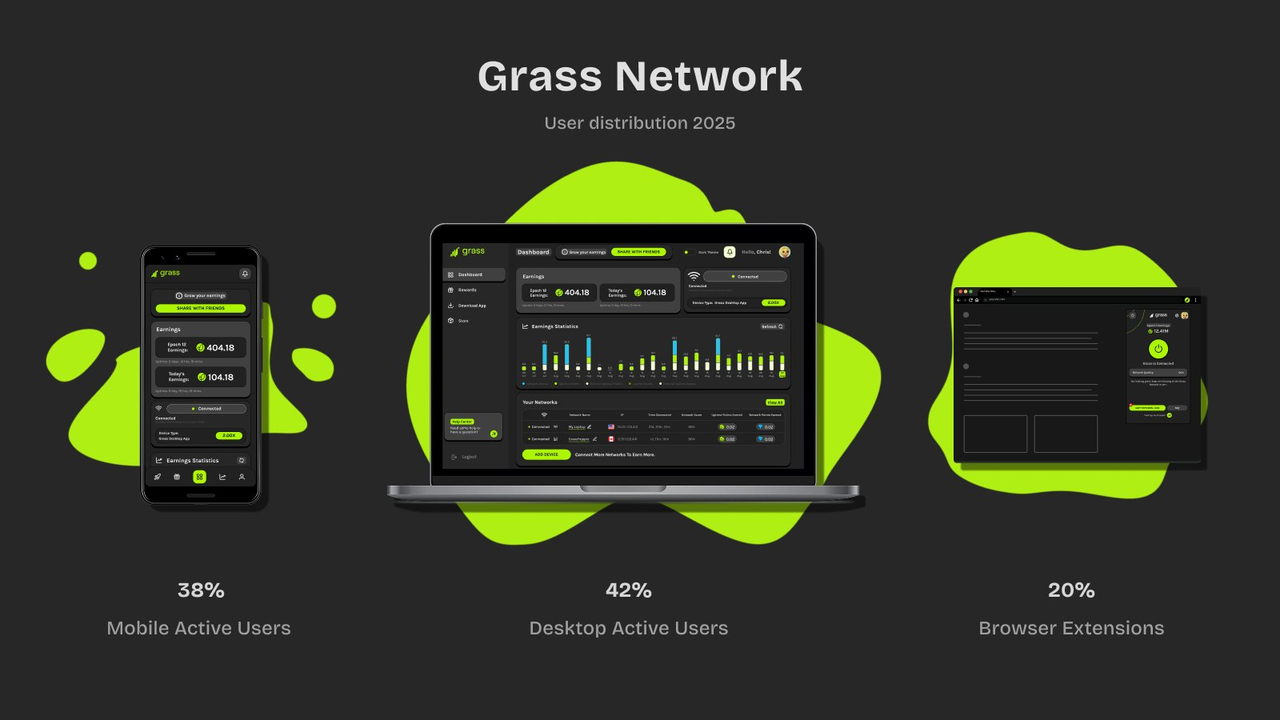
First, users install the Grass client or browser extension to connect their idle bandwidth to the Grass network. The system utilizes these resources for tasks without disrupting normal internet usage, so there’s no need for additional hardware or monetary investment—users simply keep the program running online to participate.
Next, Grass aggregates bandwidth from users worldwide into a distributed network pool, allocating these resources to data service providers, AI data collection platforms, and automated network service systems as needed. For these clients, Grass offers a more flexible and cost-effective alternative to traditional proxy networks.
After bandwidth is contributed, Grass distributes Grass Points based on factors such as online duration, network stability, and referral activity. Grass Points are currently the main incentive, but whether they can be swapped for GRASS tokens at a fixed ratio remains unclear. Points do not equate to actual token returns, so users should monitor official updates for rule changes.
What Is the Utility of the GRASS Token?
According to current disclosures, GRASS is expected to serve as the network’s native token, used for user incentives, governance participation, and potential ecosystem payments—though specific mechanisms will be detailed in future announcements.
For rewards, the GRASS token will eventually replace the points system, providing direct incentives to users who contribute bandwidth. This structure is designed to foster long-term user engagement and drive sustained growth in network resources.
Looking ahead, the GRASS token may be used for user incentives, governance, and ecosystem payments, but the exact functions will depend on official announcements. If demand-side clients are required to pay GRASS tokens for using network resources, the token will have tangible utility within the ecosystem.
Grass vs Nodepay: How Do Bandwidth Mining Projects Differ?
Grass and Nodepay are both bandwidth resource sharing projects, but they differ in reward models and ecosystem focus. Grass currently relies on point-based incentives and emphasizes network expansion, while some competitors may offer more direct return mechanisms. For users, Grass is more about early ecosystem participation than guaranteed returns.
Compared to similar projects, Grass is focused on point rewards and ecosystem growth, whereas others may offer different incentive structures. Each project’s participation model and rewards system varies, so users should evaluate their options based on official guidelines.
Grass's Potential and Long-Term Value
From a participation cost perspective, Grass is highly appealing to everyday users. There’s no need for capital investment—users can earn points simply by sharing idle bandwidth, making it an ideal low-cost airdrop opportunity.
From an investment standpoint, however, Grass’s long-term value hinges on bandwidth demand growth, the viability of its tokenomics, and the project’s ability to expand its ecosystem. Until these factors are proven, Grass should be viewed as an early-stage opportunity rather than a guaranteed investment.
What Are the Potential Risks of Grass?
Despite its popularity, Grass carries significant risks as an early-stage project.
First, the future value of Grass Points is uncertain. While points may eventually be swapped for GRASS tokens, the conversion ratio and airdrop value are not yet determined, so final returns are unpredictable.
Second, the long-term value of the GRASS token depends on real ecosystem demand. If the token lacks practical use cases or sufficient market demand, its value could be highly volatile.
Additionally, the sustainability of Grass’s business model depends on continued growth in bandwidth demand. If there aren’t enough demand-side clients, both the reward mechanism and network value could be impacted.
Finally, because Grass involves network resource sharing, varying regulatory policies across regions could create uncertainty for project development—an important risk factor for users to consider.
Summary
Grass (GRASS) is a DePIN project that builds a decentralized network resource pool by sharing idle bandwidth. Users earn Grass Points by contributing bandwidth and may receive future incentives according to official rules.
Grass’s strengths include a low entry barrier, alignment with the DePIN narrative, potential airdrop incentives, and synergy with the growing demand for AI data. However, the project still faces challenges such as uncertain rewards, unproven token value, and an immature business model. Rules and mechanisms may change, so users should always refer to official announcements.
FAQs
Does Grass Bandwidth Mining Require Capital Investment?
Grass has a low entry barrier—users just need to install the client or browser extension and share idle bandwidth, with no need for dedicated mining hardware or direct capital outlay. However, running a node does require a stable network environment.
How Are Grass Rewards Calculated?
Grass rewards are typically based on online duration, network stability, node contribution, and referral activity. The point calculation rules may change according to official policies, so the number of points earned is not fixed.
Will Grass Affect Normal Network Usage?
Grass utilizes only the idle bandwidth on user devices and generally won’t consume the entire network capacity. However, if the network environment is weak or there are many tasks, users may notice some impact on speeds.
What Are the Potential Uses of the GRASS Token?
According to project disclosures, the GRASS token may be used for user incentives, governance, and ecosystem payments in the future, but specific uses will be defined in official announcements.
What Are the Main Risks of Grass?
Key risks include uncertain point value, an undefined token mechanism, market demand fluctuations, and regulatory uncertainty. Users should review relevant rules before participating and keep up with the latest official announcements.







