
What is Lagrange (LA)?

Beginner
Quick Reads
Last Updated 2026-04-03 19:40:03
Reading Time: 1m
As ZK technology and modular blockchains continue to evolve at a rapid pace, Lagrange is positioning itself as a verifiable data indexing protocol, creating an efficient, scalable, and reliable data infrastructure for the decentralized ecosystem.

What is Lagrange?


(Source: lagrangedev)

Lagrange operates as a query-oriented coprocessor for blockchains, utilizing zero-knowledge (ZK) proofs to restructure and compress on-chain smart contract data. This makes information significantly more suitable for decentralized querying and verification. The system’s architecture draws upon the MapReduce distributed computing model—each node processes a segment of the data and generates intermediate results, which are then aggregated in multiple stages to produce an auditable, verifiable outcome. This framework drastically boosts efficiency and scalability. As a result, Lagrange can meet complex querying demands without sacrificing decentralization or security, positioning it as a pivotal solution for verifiable data in rollups, DePIN, and cross-chain use cases.

Lagrange: Technical Advantages and Core Features

  1. Modular Architecture for High Scalability
    Lagrange features a multi-subnet design, with each subnet responsible for a specific type of proof task. This allows the system to dynamically allocate resources and scale flexibly based on demand, eliminating single-point bottlenecks and delivering robust data processing for expansive rollup ecosystems.

  2. DARA Dual Auction Mechanism
    Lagrange introduces DARA, a bidirectional resource auction system that establishes the first decentralized proof market. This model not only incentivizes honest bidding and enhances computational efficiency, but also allows resource distribution to self-balance in response to market dynamics.

  3. Universal ZK Coprocessor
    Lagrange enables high-performance queries using SQL across blockchain storage, receipt logs, event data, and more. It handles both OLTP (transactional) and OLAP (analytical) workloads, allowing smart contracts to access and verify complex business logic.

  4. Advanced ZK Infrastructure and Composability
    Over 85 institutional-grade node operators have joined the Lagrange network, deployed on EigenLayer, supporting proof liveness and delivering robust economic security.

ZK Coprocessor: The Future of ZK-Based Querying

The Lagrange ZK Coprocessor is continually advancing, with several key features in the development pipeline:

  • Private Offchain Data Integration: Enables uploading of CSV data, building private tables, and performing ZK-verified queries via API.

  • Batch Query Processing: Handles multiple queries within a single circuit, improving efficiency and minimizing gas fees.

  • Support for Subqueries and Union Operations: Expands SQL capabilities, empowering deeper analytics and smarter decision-making.

  • Event Log Querying (Receipt Trie): Verifies contract events and transaction logs, increasing the queryable data spectrum.

  • Payment System: Establishes payment channels among users, operators, and query sponsors, ensuring a sustainable and cohesive economic model.

Lagrange Tokenomics

Token Supply and Circulation Mechanics

  • Total Supply: 1 billion $LA tokens

  • Annual Inflation Rate: Fixed at 4%, distributed to provers in proportion to proofs generated

  • Initial Unlock: 19.3% of tokens become liquid at the Token Generation Event (TGE)

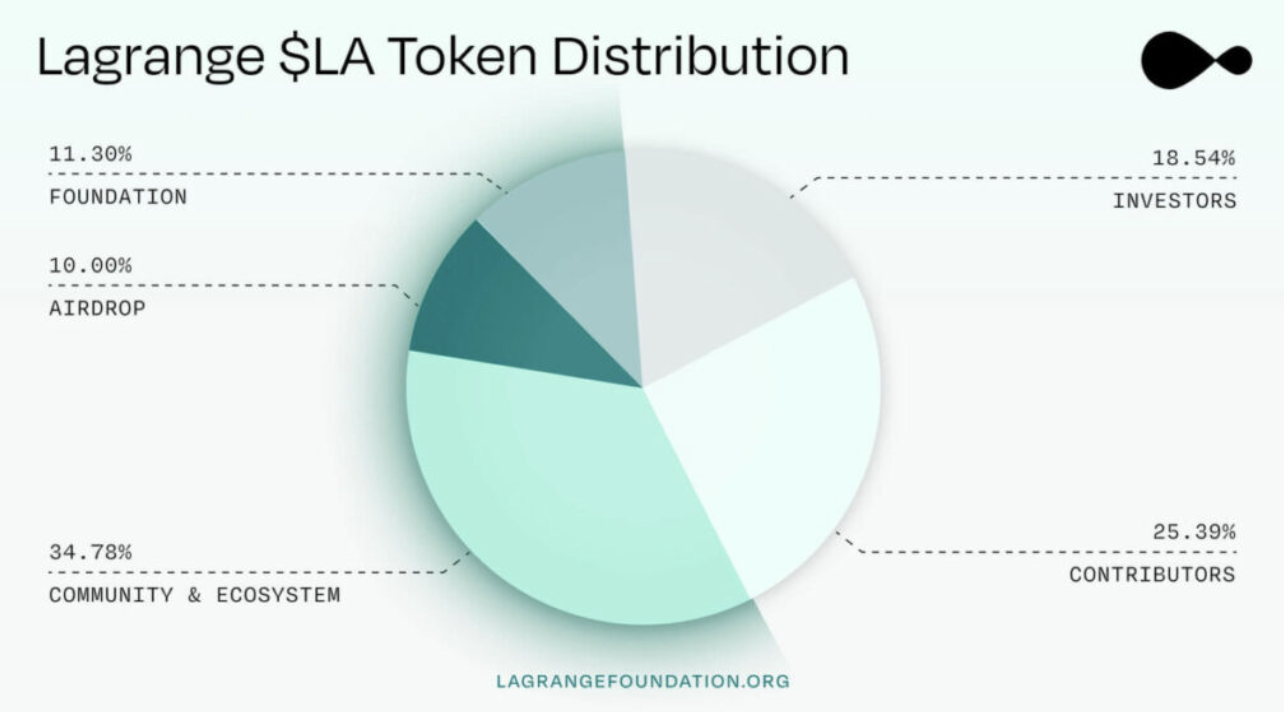
Distribution Breakdown (Based on Total Supply):

  • Community & Ecosystem: 34.78%
    Allocated for promotion, developer grants, and incentives. 5% unlocked at TGE; the remaining 95% locked for six months, then released linearly over 48 months.

  • Early Contributors & Team: 25.39%
    Locked for one year, followed by linear vesting over 24 months.

  • Investors: 18.54%
    Locked for one year, followed by linear vesting over 24 months.

  • Lagrange Foundation: 11.30%
    Supports protocol governance, operations, and cross-chain collaboration initiatives.

  • Community Airdrop: 10%
    Distributed in phases to reward and incentivize participants and supporters.

(Source: lagrange.foundation)

LA Token Utility and Value Accrual Mechanisms

  • Proof Generation Fees: All query and verification operations are settled in $LA.

  • Node Incentives: Operators earn $LA rewards based on the volume of proofs generated.

  • Staking and Delegation: Holders may stake $LA with operators, lowering operational costs and sharing in rewards.

  • Automated Buyback: When users pay in ETH or USDC for queries, the protocol automatically converts these assets to purchase $LA, creating positive buy pressure.

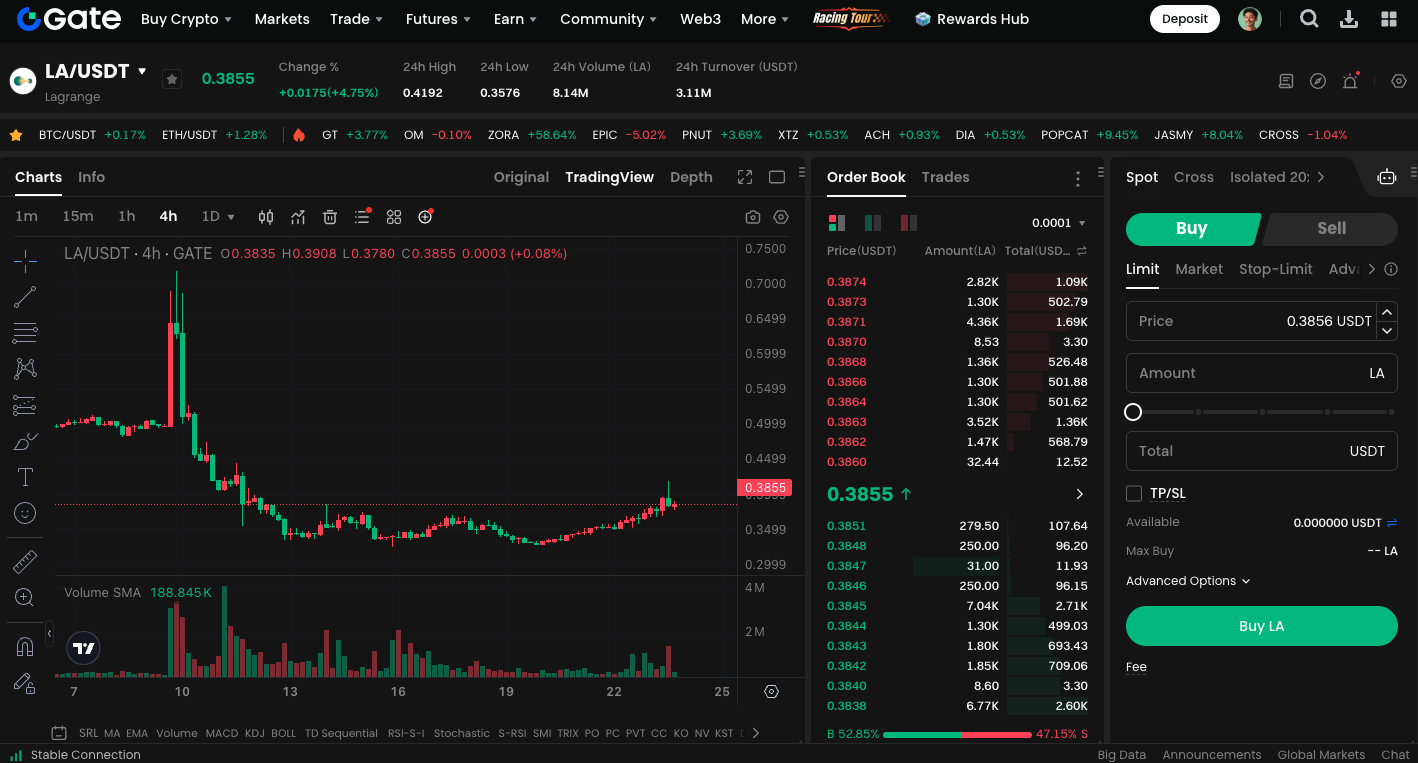
Begin trading LA spot pairs now: https://www.gate.com/trade/LA_USDT
Conclusion

Lagrange is paving a new data superhighway for Web3. From reconstructing on-chain data structures to integrating secure private data queries and establishing a robust economic incentive model, Lagrange stands as both the execution layer for ZK proofs and an indispensable component of next-generation dApp infrastructure. As ZK applications scale to mainstream adoption, Lagrange will play a vital role in enabling data availability and fostering cross-chain trust across the blockchain ecosystem.

Author: Allen
Disclaimer
* The information is not intended to be and does not constitute financial advice or any other recommendation of any sort offered or endorsed by Gate.
* This article may not be reproduced, transmitted or copied without referencing Gate. Contravention is an infringement of Copyright Act and may be subject to legal action.

Related Articles

What is Fartcoin? All You Need to Know About FARTCOIN
Intermediate

What is Fartcoin? All You Need to Know About FARTCOIN

Fartcoin (FARTCOIN) is a representative meme coin within the Solana ecosystem based on an AI-driven narrative. Its core concept originated from an experiment aimed at exploring the "boundaries between AI Agents and humor." More than just a digital asset with social attributes, the project deeply couples absurd humor culture with on-chain financial logic by integrating autonomous AI interaction models.
2026-04-04 22:01:19
Gold Price Forecast for the Next Five Years: 2026–2030 Trend Outlook and Investment Implications, Could It Reach $6,000?
Beginner

Gold Price Forecast for the Next Five Years: 2026–2030 Trend Outlook and Investment Implications, Could It Reach $6,000?

Analyze current gold price trends alongside authoritative five-year forecasts, integrating an evaluation of market risks and opportunities. This gives investors insight into the potential trajectory of gold prices and the main drivers expected to shape the market over the next five years.
2026-03-25 18:13:30
Aster vs Hyperliquid: Which Perp DEX Will Prevail?
Beginner

Aster vs Hyperliquid: Which Perp DEX Will Prevail?

Aster and Hyperliquid are the two representative protocols of the "purpose-built L1 path" within the current decentralized perpetual exchange (Perp DEX) sector. As a pioneer in the field, Hyperliquid has built a deep liquidity moat through its highly mature order book architecture and strong community consensus. Conversely, Aster, as a rising challenger, seeks to leapfrog the competition in high-performance trading through more aggressive multi-chain aggregation logic, private transaction modules, and an underlying execution environment optimized for 2026 market demands.
2026-03-24 11:58:33
AI-Native Settlement Layers: How United Stables Is Building the Next Financial Rail
Beginner

AI-Native Settlement Layers: How United Stables Is Building the Next Financial Rail

Stablecoins were originally designed as dollar substitutes within exchanges, primarily used for asset pricing and trade settlement. As on-chain financial ecosystems have matured, their role has expanded beyond simple payments to include collateral assets, cross-chain liquidity mediums, and unified settlement units. In particular, as AI systems and automated agents begin to participate directly in economic activity, demand has risen sharply for programmable value units capable of instant settlement. This shift is pushing stablecoins toward the role of foundational financial infrastructure.
2026-03-25 03:16:17
Aerodrome Tokenomics: How ve(3,3) Powers Base's Most Profitable DEX
Beginner

Aerodrome Tokenomics: How ve(3,3) Powers Base's Most Profitable DEX

AERO is the native token of Aerodrome Finance, a core decentralized exchange and liquidity protocol in the Base ecosystem. It is primarily used for liquidity incentives and ecosystem operations. veAERO is a governance NFT that users receive by locking AERO, representing both voting power and the right to share protocol revenue. Through a dual track structure of AERO as a utility token and veAERO as a governance credential, Aerodrome separates liquidity usage value from long term governance power, allowing participants to act as liquidity providers, governance decision makers, and revenue sharers within the same system.
2026-03-25 06:40:31
The ve(3,3) Flywheel Explained: How AERO Tokenomics Powers Aerodrome’s DeFi Economy
Beginner

The ve(3,3) Flywheel Explained: How AERO Tokenomics Powers Aerodrome’s DeFi Economy

In the competition for DeFi liquidity, high-inflation mining alone is no longer enough to build lasting advantages. Aerodrome applies the ve(3,3) economic model to redesign token emissions, voting mechanisms, and revenue distribution, creating a liquidity flywheel centered on governance and cash flow. This article examines AERO tokenomics, the veAERO locking mechanism, and protocol revenue models to explain how Aerodrome builds a sustainable DeFi economic system.
2026-03-25 06:41:58