A controversial proposal is stirring up a huge debate in the Hyperliquid (HYPE) community, suggesting the destruction of up to 45% of the $HYPE Token total supply. This bold move could fundamentally alter the tokenomics of $HYPE, having a profound impact on its market valuation. What intentions are hidden behind the proposal? Is it pure value optimization or a careful calculation by institutional investors?
The Mystery of Supply: The 'Invisible Inflation' Issue of $HYPE
In the increasingly competitive environment of major Perp DEX, Hyperliquid, as a leading player in the industry, faces unique challenges. Unlike other emerging platforms, the issue with $HYPE lies not in functional innovation, but in the structural flaws in its tokenomics design.
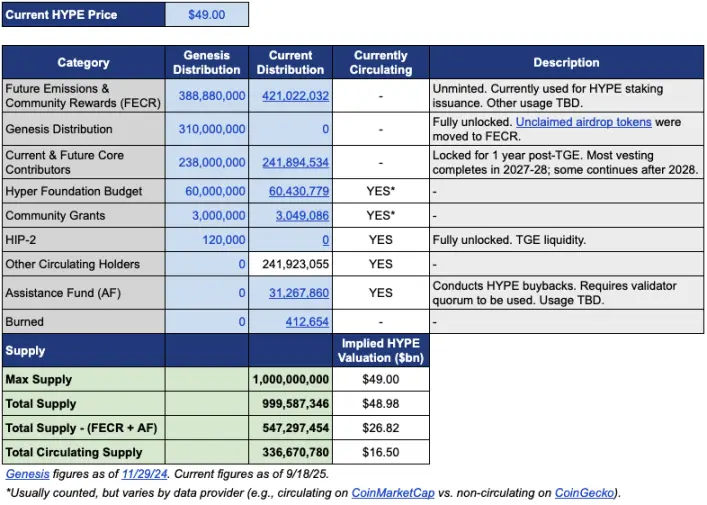
The current Token supply structure of $HYPE shows a clear imbalance:
· Circulating supply: Approximately 339 million coins, corresponding to a market value of about 154 billion US dollars
· Total supply: close to 1 billion coins, corresponding to a FDV of up to 460 billion US dollars
· The difference between market capitalization and FDV is nearly 3 times.
This huge gap mainly stems from two key components:
-
Future Emissions and Community Rewards (FECR): Up to 421 million Tokens, accounting for 42% of the total supply
-
Assistance Fund (AF) holdings: 31.26 million coins, repurchased by agreement but never destroyed
“This design makes $HYPE look more expensive than Ethereum,” commented a crypto analyst, “even though only one-third of the total supply is actually in circulation.”
The core content of the radical proposal: reshaping $HYPE Tokenomics
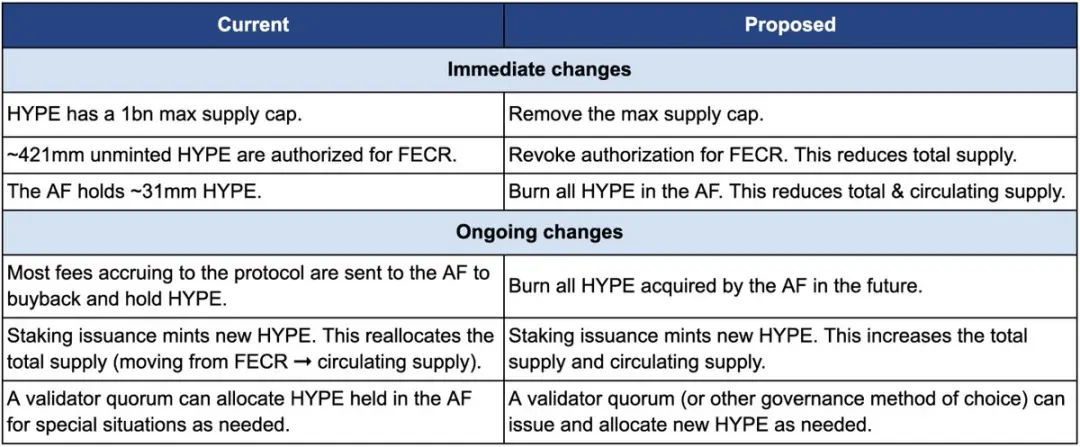
Investment manager Jon Charbonneau (DBA Asset Management) and independent researcher Hasu's unofficial proposal on September 22 quickly sparked community discussion and has received over 410,000 views as of press time.
The Three Core Actions of the Proposal
1. Revoke the authorization of 421 million FECR
· The Tokens originally intended for future staking rewards and community incentives will be fully revoked.
If you need to proceed in the future, you must obtain re-approval through governance voting.
2. Destroy all Tokens held in the Aid Fund
· Immediately destroy the existing 31.26 million $HYPE
· All Tokens repurchased by the Future Agreement will also be directly burned, not held.
3. Remove the supply cap of 1 billion coins
· Remove the fixed cap and switch to a governance-based approach to determine the supply on demand.
· Increase the transparency and accountability of Token supply
“This is just to make the ledger more honest,” Jon emphasized in the proposal, “It will not affect the relative share of existing holders, nor will it affect the ability of Hyperliquid to fund projects.”
The real motive behind the proposal: Who is the biggest beneficiary?
On the surface, this proposal aims to solve the 'accounting issue' of $HYPE, making the Token valuation more transparent. However, a deeper analysis of the various positions can reveal a more complex game of interests.
Jon is frank in the proposal: “Many investors, including some of the largest and most mature funds, only look at the surface FDV numbers.”
This view was echoed by Haseeb Qureshi, a partner at Dragonfly Capital: “Professional investors automatically discount these 'community reserves' by 50% when evaluating projects.”
In other words, one of the core purposes of the proposal is to make $HYPE more attractive to institutional investors by lowering FDV to attract more large funds.
Transparency of interests
It is worth noting that the proposer Jon Charbonneau explicitly stated that the DBA Fund he manages holds a $HYPE “significant position,” which he also personally holds. If the proposal is passed:
· A 45% reduction in supply could lead to a significant increase in Token price
· Institutional investors holding a large amount of $HYPE will be the biggest beneficiaries
· The timing of the proposal coincided with Arthur Hayes just selling $HYPE for 800,000 US dollars.
“The subtle coincidences at this time are hard not to associate with,” commented a community member.
Community Dispute: The Battle of the “Sacred Cow” in the Cryptocurrency Industry
The debate brought up by the proposal goes beyond a simple discussion of tokenomics, touching on the core values of the crypto industry.
Haseeb Qureshi puts the proposal in the context of a larger industry phenomenon: “There are some 'sacred cows' in the crypto industry that just can't die, it's time to slaughter.”
He is referring to an unwritten rule in the entire industry: the project party always has to reserve 40-50% of the Token for the “community”, but the specific use of these Tokens is often unclear.
“At the peak of the bull market in 2021, every project was competing to be more 'decentralized',” observed an industry observer. “In the tokenomics, it's considered more politically correct to allocate 50%, 60%, or even 70% to the community.”
Three Major Arguments Against Voice
The opponents in the community mainly raise three questions:
1. Risk Management Considerations
The Token held by AF is emergency funds, used to deal with possible regulatory fines or hacker attacks
Burning all reserves is equivalent to losing the buffer in times of crisis.
2. The effectiveness of the existing destruction mechanism
· Hyperliquid has three natural destruction mechanisms: spot trading fees, HyperEVM gas fees, and Token auction fees
· Based on the natural burn rate of use, it is healthier than one-time artificial intervention.
3. Sustainability of Incentive Mechanism
· Future emissions are an important tool for incentivizing users and contributors on the platform
· Without new Token rewards, the enthusiasm of the stakers may decrease significantly
The philosophical debate of Tokenomics: serving big capital or grassroots users?
At the core of this debate is actually a more fundamental question: Who should a chain-based project really serve?
Two completely different perspectives
Institutional Investor Perspective: Large funds are the main driving force behind price increases, and projects should adjust their economic models to attract these funds.
Community Perspective: The retail users who actually trade on the platform are the foundation. The success of Hyperliquid relies on the support of 94,000 airdrop users, not VC funding.
“This divergence is not uncommon in the history of DeFi,” a seasoned industry professional pointed out, “When it comes to Uniswap coin, the community and investors have argued endlessly over control of the treasury.”
Conclusion: Balancing Transparency and Value
Regardless of how Hyperliquid ultimately decides, this debate has revealed a core contradiction facing the crypto industry: how to balance the pursuit of real value with maintaining traditional tokenomics design.
Supporters of the proposal believe that a more transparent Token supply structure will make the value of $HYPE more real, benefiting long-term development.
Opponents, on the other hand, are concerned that changing the economic model to cater to institutional investors may deviate from the project's original intention and sacrifice long-term incentive mechanisms.
As of the deadline, Hyperliquid has not yet made a formal response to the proposal. However, regardless of the final outcome, this debate will have a profound impact on the tokenomics of the entire industry.


