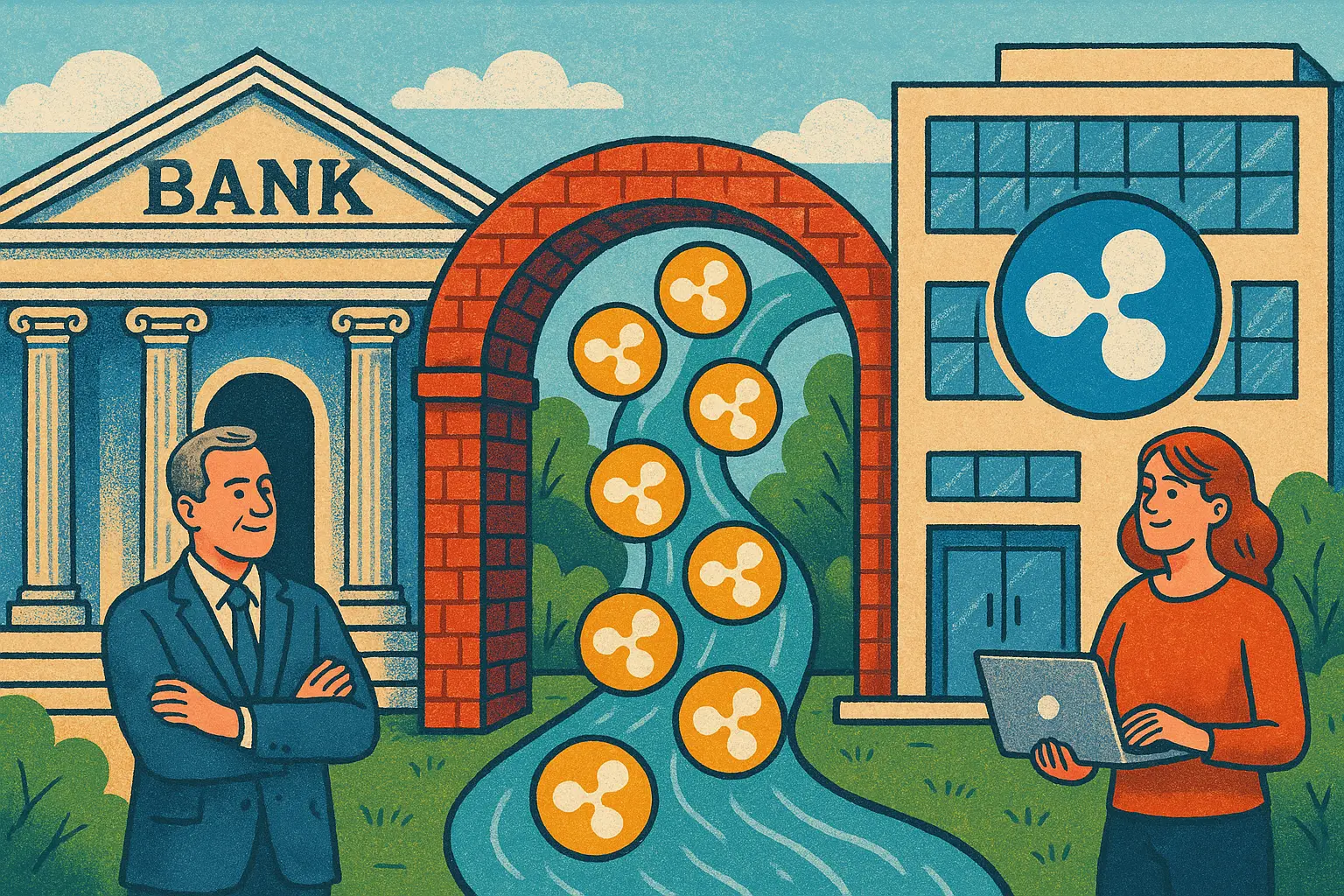
The Office of the Comptroller of the Currency (OCC) announced revisions to regulations related to national bank charters, officially permitting national trust banks to engage in non-trust activities while performing trust duties, thereby eliminating previous industry concerns about the compliance of such activities. For Ripple, Circle, and other companies that have conditionally received national trust bank licenses, this regulation opens a crucial pathway into the U.S. banking system.
OCC Revises Trust Bank Regulations: Key Policy Insights
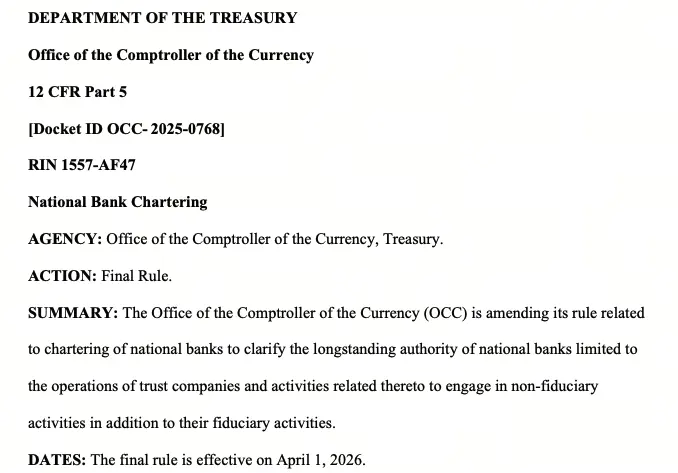 (Source: OCC)
The final OCC regulation confirms that national trust banks can conduct ancillary banking activities beyond solely trust services. Previously, there was industry concern: whether companies holding trust charters had the authority to engage in broader banking operations. The OCC’s final ruling explicitly answers this question — yes, they can.
Major crypto companies with conditional OCC trust bank licenses
Ripple: Expanding crypto asset custody services; recently partnered with Figment to extend custody to staking services on Ethereum and Solana.
Circle: USDC stablecoin issuer; leveraging this to strengthen its business presence within the U.S. banking compliance framework.
Paxos: Deepening its involvement in blockchain settlement; expanding institutional services through bank system integration.
This is a significant policy victory for the cryptocurrency industry, which has actively advocated for the finalization of these rules. Such integration further accelerates the convergence of cryptocurrencies and traditional finance (TradFi).
Federal Reserve’s Simplified Master Account Program: The Next Step for Crypto Access to Payment Systems
In addition to OCC policies, the Federal Reserve is advancing a “Simplified Master Account” plan, which, if implemented, would allow companies like Ripple and Circle limited access to the Fed’s payment system. Fed Governor Chris Waller proposed this plan, with plans to announce related regulations in Q4 of this year.
However, this plan faces clear resistance. The crypto industry and banking sector are at odds; banks believe crypto companies should not have direct access to the Fed’s payment system, and the Colorado Bankers Association has warned that such accounts could facilitate rapid fraud.
Fed Governor Michelle Bowman stated during a Senate Banking Committee hearing that the Fed is working with other banking regulators to develop regulations covering capital and liquidity requirements for stablecoin issuers (including those mandated by the GENIUS Act), clarifying which digital asset activities are permitted, and is open to providing regulatory feedback on new use cases. The regulatory framework for crypto companies entering the U.S. banking system is gradually taking shape, though final rules will take time to implement.
Frequently Asked Questions
Q: What does the OCC new regulation mean for Ripple?
A: The OCC allows national trust banks to engage in non-trust activities (including non-trust custody services), enabling Ripple, which has received conditional approval, to hold and manage customer crypto assets within a compliant framework without traditional fiduciary responsibilities. This provides a clear legal basis for Ripple’s entry into the U.S. banking system and expansion of institutional custody services.
Q: Besides Ripple, which other crypto companies benefit from the OCC new regulation?
A: Circle, Paxos, and Crypto.com have also received conditional approval for OCC national trust bank licenses, benefiting from this regulatory revision alongside Ripple, marking the first tier of crypto firms integrating into the regulated U.S. banking system.
Q: How are the Fed’s Simplified Master Account plan and the OCC regulation related?
A: Both are complementary pathways for crypto companies to access the U.S. financial system. The OCC regulation addresses the scope of trust bank activities; the Fed’s plan further allows these companies to directly connect to the payment system, though it faces greater resistance from the banking industry and is still under development.
Disclaimer: The information on this page may come from third parties and does not represent the views or opinions of Gate. The content displayed on this page is for reference only and does not constitute any financial, investment, or legal advice. Gate does not guarantee the accuracy or completeness of the information and shall not be liable for any losses arising from the use of this information. Virtual asset investments carry high risks and are subject to significant price volatility. You may lose all of your invested principal. Please fully understand the relevant risks and make prudent decisions based on your own financial situation and risk tolerance. For details, please refer to
Disclaimer.
Related Articles
Franklin Templeton, Ondo Finance Bring 24/7 Tokenized ETF Trading to Crypto Users
In brief
Franklin Templeton and Ondo Finance are teaming up to tokenize five of the financial giant's ETFs.
Offerings include Franklin Templeton's responsibly sourced gold ETF and its high-yield corporate ETF.
The tokenized ETFs will be offered via Ondo's Global Markets platform, which
Decrypt4h ago
Bitcoin Depot CEO Resigns as Company Signals Business Contraction
Bitcoin Depot undergoes leadership changes, with Alex Holmes replacing Scott Buchanan amid increasing regulatory scrutiny and a projected revenue decline of 30-40%. The company faces heightened compliance costs and challenges in the Bitcoin ATM sector.
LiveBTCNews4h ago
Solana Foundation: Positioning the network as the core infrastructure of the "Internet of Intelligent Agents"
Solana Foundation plans to position its network as core infrastructure for an emerging "agentic internet," where AI systems initiate economic activity. Chief Product Officer Vibhu Norby stated that AI will impact various industries, and Solana's payment infrastructure has already processed approximately 15 million agent-initiated payments. In the future, this will reshape internet business models and drive the development of micropayments and pay-per-use models.
GateNews5h ago
Sky-backed Obex spreads $1 billion across credit, energy and AI assets to expand stablecoin yield
Obex is deploying $1 billion to link Sky's USDS stablecoin with income from tangible assets, moving beyond crypto yields. The initiative includes partnerships to tokenize real-world assets, aiming for stable returns and broader investment access, while expanding the tokenized asset market's rapid growth.
CoinDesk5h ago
Solana bets on AI agents: Foundation says network is becoming core infrastructure for ‘agentic’ internet
The Solana Foundation aims to establish its network as essential for a new "agentic" internet driven by AI, focusing on payments and machine-to-machine commerce. This shift could transform internet monetization and user interactions with crypto, emphasizing Solana's advantages in programmatic payments.
CoinDesk5h ago
Deloitte and Stablecorp Launch QCAD, a Stablecoin Infrastructure for Canadian Financial Institutions
Deloitte and Stablecorp are partnering to integrate QCAD into banking systems, enhancing digital transactions. This initiative supports Canada's Bill C-15, focusing on interbank clearing, cross-border payments, and improving payment efficiency using blockchain.
CryptoFrontNews6h ago


