
# rsETHAttackUpdate

101.94K
#rsETHAttackUpdate
WHEN DEFI STOPPED SCALING AND STARTED STRESS-TESTING ITSELF
April 18, 2026 didn’t produce a typical “hack headline.”
It produced something far more uncomfortable for the entire crypto ecosystem:
A live demonstration that composability can become contagion under pressure.
The rsETH incident tied to KelpDAO was not just another exploit in the long list of DeFi failures.
It was a structural failure event where assumptions broke before systems did.
And that difference matters.
HOW IT ACTUALLY UNFOLDED: A SYSTEM OVERRIDDEN, NOT BROKEN
The attacker didn’t “break into” a protocol
ZRO-2,48%
AAVE-0,3%
ETH0,56%
post-image
post-image
  • Reward
  • 3
  • Repost
  • Share
HighAmbition:
good 💯💯💯
View More
#rsETHAttackUpdate
rsETH Attack Update: A Comprehensive Analysis of the KelpDAO Exploit and Its Impact on Crypto Markets
April 18, 2026 will be remembered as a defining moment in DeFi history, when KelpDAO’s rsETH token became the center of a massive cross-chain exploit that sent shockwaves across the entire crypto market. This was not just a hack involving stolen funds, but a deep structural failure that exposed how fragile cross-chain systems can be, while at the same time testing the strength, behavior, and psychology of market participants in real time.
The Exploit: Technical Breakdown
Th
ZRO-2,48%
ETH0,56%
HighAmbition
#rsETHAttackUpdate
rsETH Attack Update: A Comprehensive Analysis of the KelpDAO Exploit and Its Impact on Crypto Markets
April 18, 2026 will be remembered as a defining moment in DeFi history, when KelpDAO’s rsETH token became the center of a massive cross-chain exploit that sent shockwaves across the entire crypto market. This was not just a hack involving stolen funds, but a deep structural failure that exposed how fragile cross-chain systems can be, while at the same time testing the strength, behavior, and psychology of market participants in real time.
The Exploit: Technical Breakdown
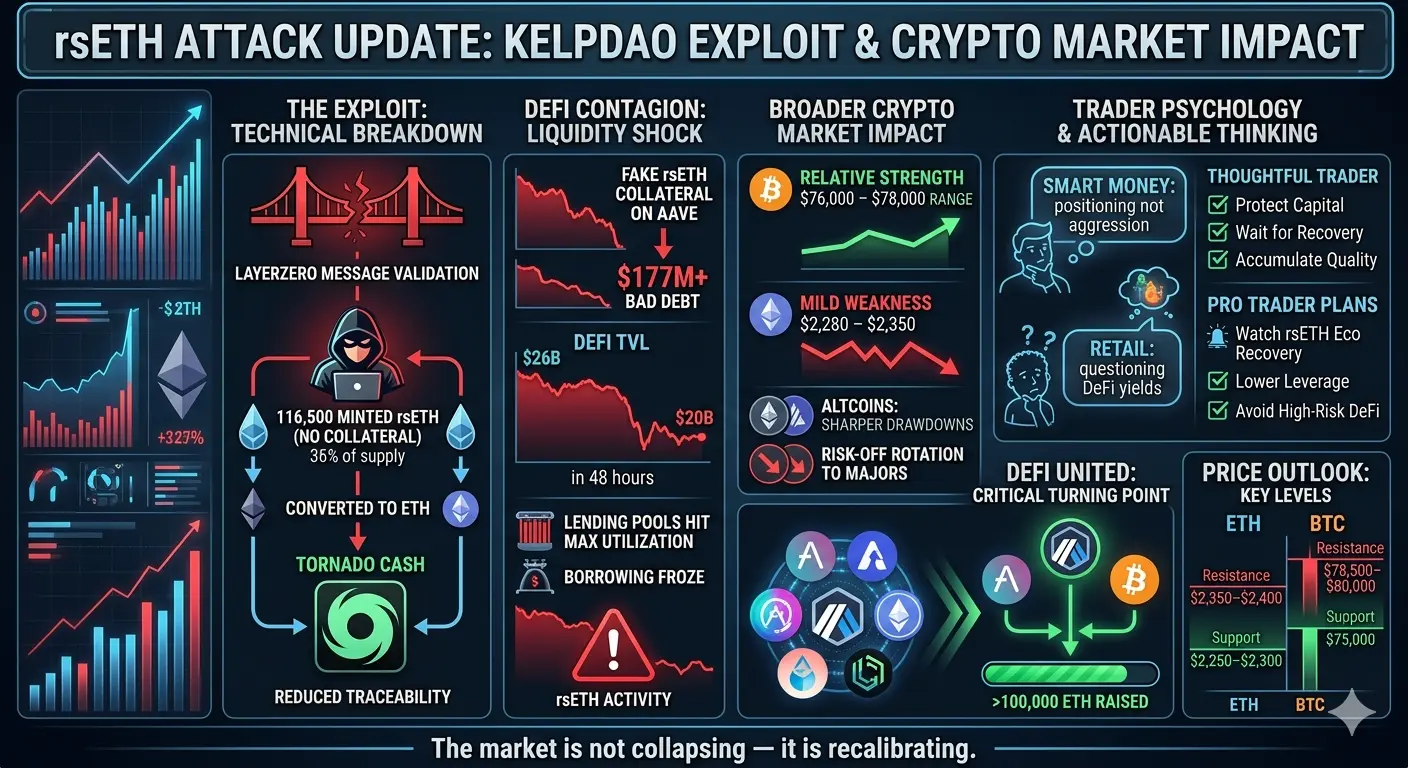
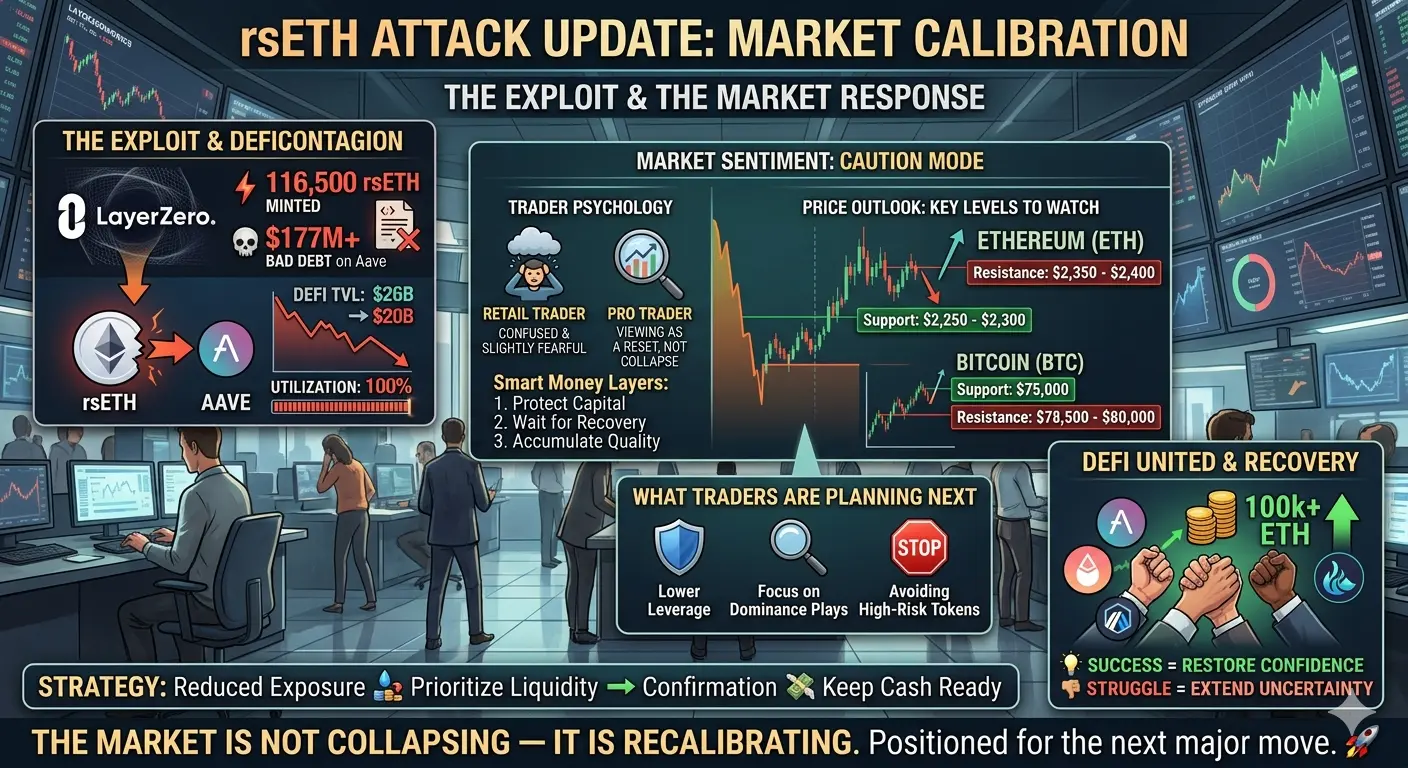
The attacker targeted LayerZero infrastructure and exploited a flaw in cross-chain message validation, allowing them to mint approximately 116,500 rsETH without depositing any real collateral. This represented nearly 36% of the supply and instantly created a synthetic liquidity shock that rippled across DeFi.
After minting, the attacker moved funds strategically, converted them into ETH, and routed them through Tornado Cash to reduce traceability, showing a high level of planning and execution.
The DeFi Contagion: Liquidity Shock Across the Market
The real crisis began when the attacker used fake rsETH as collateral on Aave and extracted around 106,000 ETH, leaving over $177 million in bad debt. This triggered a liquidity crunch where lending pools hit maximum utilization, borrowing froze, and multiple protocols had to shut down rsETH-related activity.
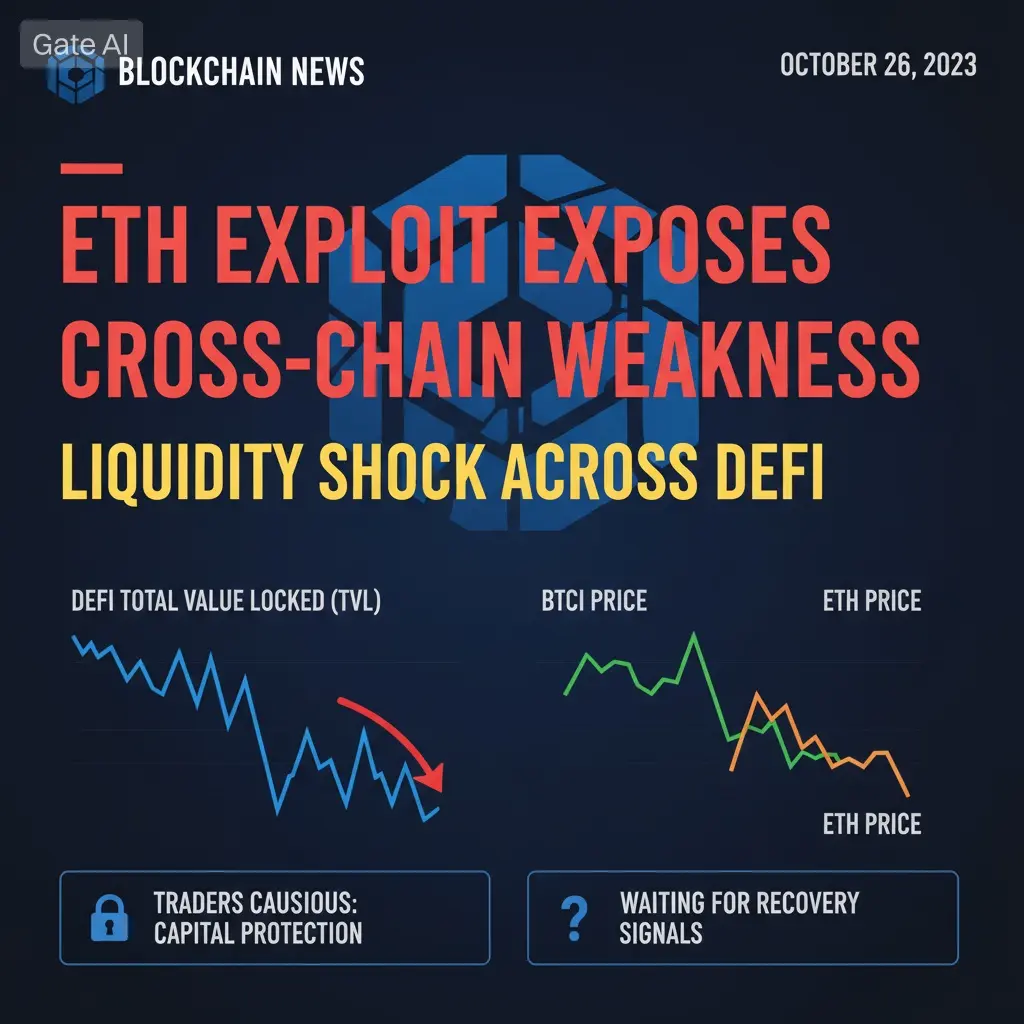
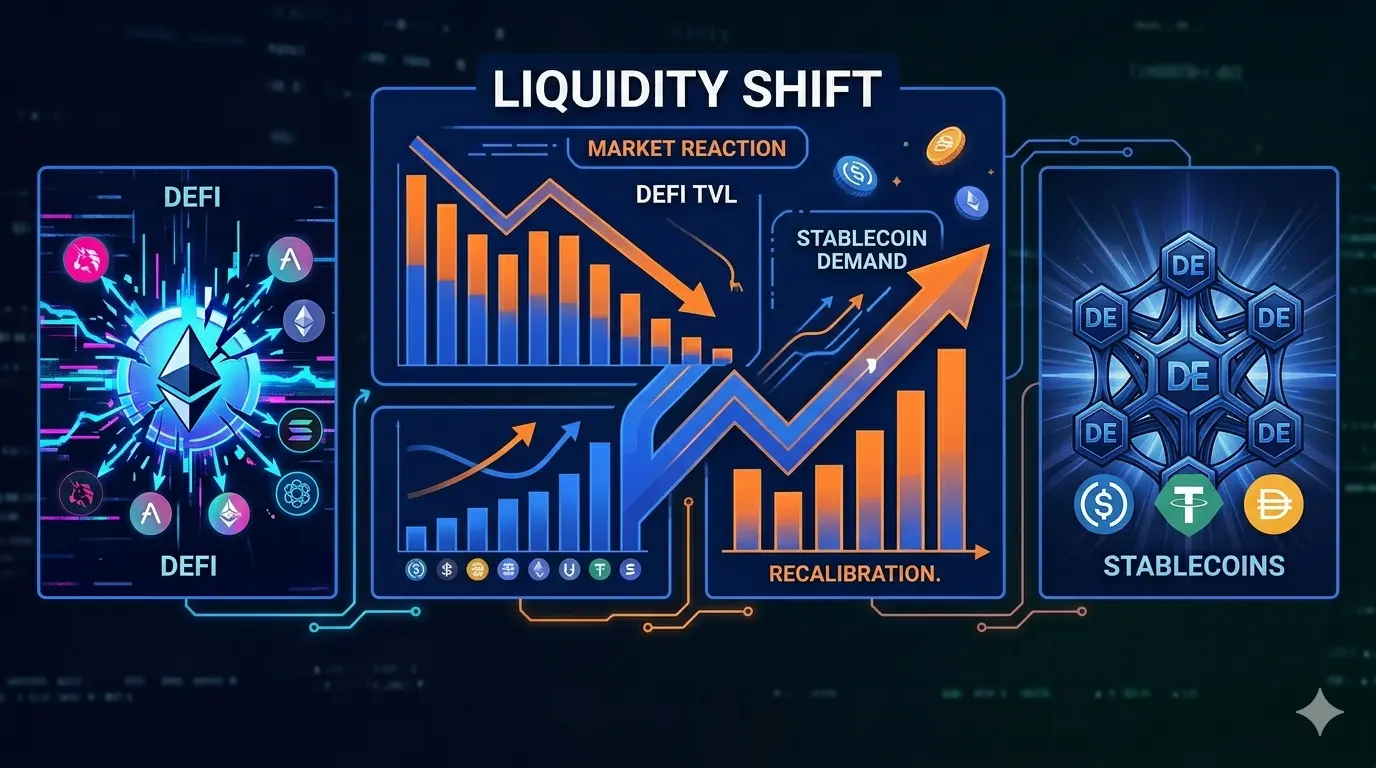
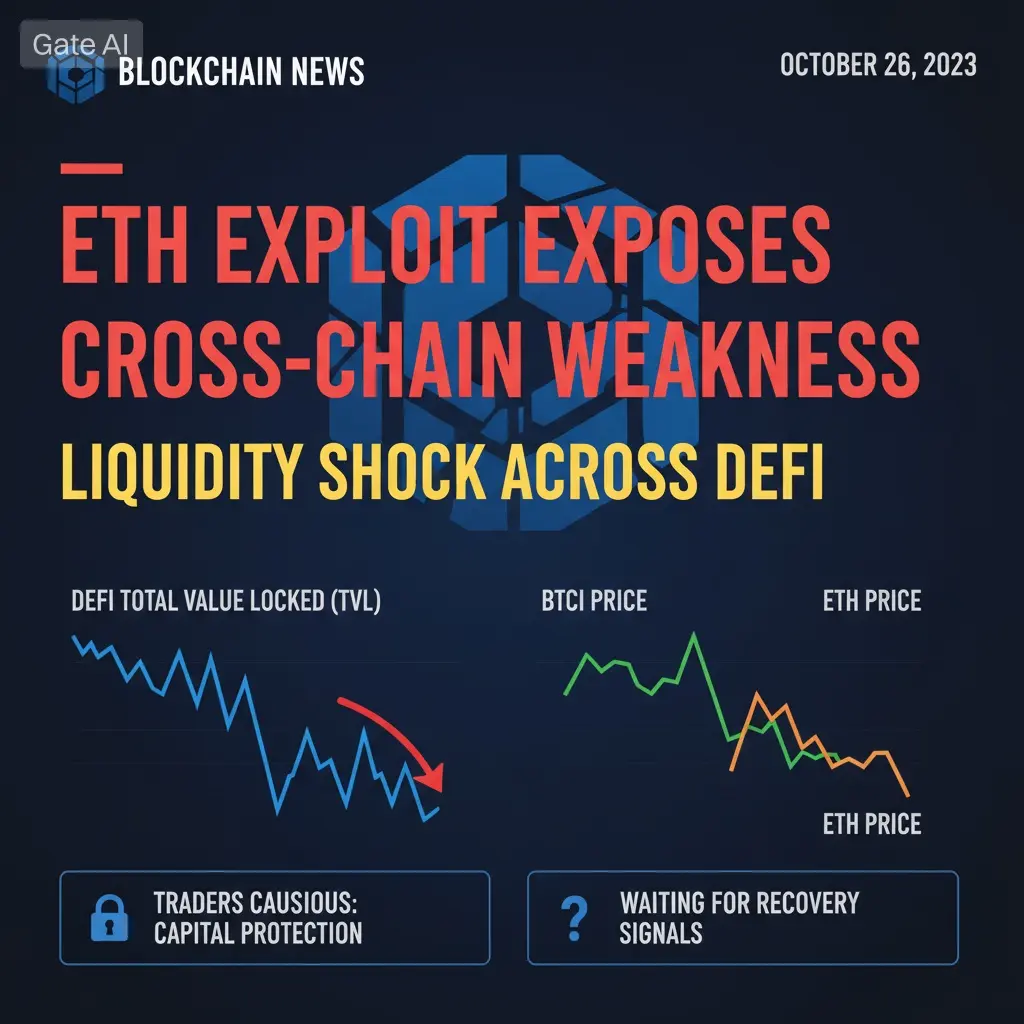
Within 48 hours, DeFi TVL dropped from $26 billion to nearly $20 billion, clearly showing that the impact was not isolated but systemic. Capital began exiting high-risk pools rapidly, and network congestion increased as users rushed to reposition.
Impact on the Broader Crypto Market
This event did not stay limited to DeFi, as it directly influenced the broader crypto market sentiment.
Bitcoin held relatively strong around the $76,000–$78,000 range, acting as a safe haven, while Ethereum showed mild weakness and hovered around $2,280–$2,350 due to its deeper exposure to DeFi.
Altcoins, especially those connected to DeFi narratives, experienced sharper drawdowns as traders reduced risk exposure. Liquidity shifted from speculative tokens toward majors like BTC and ETH, reflecting a classic risk-off rotation inside crypto itself.
Trader Psychology: What the Market Is Thinking
Right now, the market is not in panic mode, but it is definitely in caution mode.
Retail traders are confused and slightly fearful, questioning the safety of DeFi yields and cross-chain systems, while experienced traders are viewing this as a reset phase rather than a collapse.
Smart money is thinking in three layers:
Short-term: Protect capital and avoid unstable protocols
Mid-term: Wait for confirmation of recovery (DeFi United success)
Long-term: Accumulate quality assets at discounted levels
This difference in mindset is critical because it shows that the market is rotating, not exiting.
What Traders Are Planning Next
Professional traders are not chasing trades right now; instead, they are preparing for the next move.
Most are watching key triggers:
Recovery progress of rsETH ecosystem
Stability in lending protocols
Ethereum price holding key support
Their plans include:
Entering after confirmation, not during chaos
Focusing on BTC and ETH dominance plays
Avoiding high-risk DeFi tokens temporarily
Using lower leverage due to unpredictable volatility
In simple terms:
👉 Right now is a positioning phase, not an aggression phase.
DeFi United: A Critical Turning Point
The coordinated effort by protocols like Aave, Arbitrum, and Lido to raise over 100,000 ETH is being closely watched by the market.
If this initiative succeeds, it could restore confidence and trigger a relief rally across DeFi assets. If it struggles, it may extend uncertainty and delay recovery.
Price Outlook: Key Levels to Watch
For Ethereum:
Strong support: $2,250 – $2,300
Key resistance: $2,350 – $2,400
If ETH holds support and breaks resistance, momentum could push toward $2,500. However, if support fails, a deeper retracement toward $2,150 is possible.
For Bitcoin:
Support: $75,000
Resistance: $78,500 – $80,000
BTC strength remains a key indicator of overall market stability.
Strategy: How Smart Traders Are Navigating This
In the current environment, traders are focusing on:
Reducing exposure to complex cross-chain ecosystems
Prioritizing liquidity and capital preservation
Entering trades only after confirmation signals
Keeping cash or stablecoin reserves ready for opportunities
This is not a market for impulsive decisions; it is a market for disciplined execution.
Conclusion
The rsETH exploit has temporarily shaken confidence, but it has not broken the crypto market. Instead, it has highlighted the difference between weak and strong systems, emotional and strategic traders, and short-term panic versus long-term conviction.
In the short term, volatility and uncertainty will remain elevated, but in the long term, this event is likely to lead to stronger infrastructure, better risk management, and a more mature DeFi ecosystem.
The market is not collapsing — it is recalibrating.
And those who understand this phase will be the ones best positioned for the next major move
repost-content-media
  • Reward
  • 1
  • Repost
  • Share
GateUser-510a718d:
#OpenAIReleasesGPT-5.5
AI infrastructure spending is entering a historic expansion phase — with capital flows projected in the trillions..
#rsETHAttackUpdate
rsETH Attack Update: A Comprehensive Analysis of the KelpDAO Exploit and Its Impact on Crypto Markets
April 18, 2026 will be remembered as a defining moment in DeFi history, when KelpDAO’s rsETH token became the center of a massive cross-chain exploit that sent shockwaves across the entire crypto market. This was not just a hack involving stolen funds, but a deep structural failure that exposed how fragile cross-chain systems can be, while at the same time testing the strength, behavior, and psychology of market participants in real time.
The Exploit: Technical Breakdown
Th
ETH0,56%
BTC0,67%
ZRO-2,48%
AAVE-0,3%
HighAmbition
#rsETHAttackUpdate
rsETH Attack Update: A Comprehensive Analysis of the KelpDAO Exploit and Its Impact on Crypto Markets
April 18, 2026 will be remembered as a defining moment in DeFi history, when KelpDAO’s rsETH token became the center of a massive cross-chain exploit that sent shockwaves across the entire crypto market. This was not just a hack involving stolen funds, but a deep structural failure that exposed how fragile cross-chain systems can be, while at the same time testing the strength, behavior, and psychology of market participants in real time.
The Exploit: Technical Breakdown
The attacker targeted LayerZero infrastructure and exploited a flaw in cross-chain message validation, allowing them to mint approximately 116,500 rsETH without depositing any real collateral. This represented nearly 36% of the supply and instantly created a synthetic liquidity shock that rippled across DeFi.
After minting, the attacker moved funds strategically, converted them into ETH, and routed them through Tornado Cash to reduce traceability, showing a high level of planning and execution.
The DeFi Contagion: Liquidity Shock Across the Market
The real crisis began when the attacker used fake rsETH as collateral on Aave and extracted around 106,000 ETH, leaving over $177 million in bad debt. This triggered a liquidity crunch where lending pools hit maximum utilization, borrowing froze, and multiple protocols had to shut down rsETH-related activity.
Within 48 hours, DeFi TVL dropped from $26 billion to nearly $20 billion, clearly showing that the impact was not isolated but systemic. Capital began exiting high-risk pools rapidly, and network congestion increased as users rushed to reposition.
Impact on the Broader Crypto Market
This event did not stay limited to DeFi, as it directly influenced the broader crypto market sentiment.
Bitcoin held relatively strong around the $76,000–$78,000 range, acting as a safe haven, while Ethereum showed mild weakness and hovered around $2,280–$2,350 due to its deeper exposure to DeFi.
Altcoins, especially those connected to DeFi narratives, experienced sharper drawdowns as traders reduced risk exposure. Liquidity shifted from speculative tokens toward majors like BTC and ETH, reflecting a classic risk-off rotation inside crypto itself.
Trader Psychology: What the Market Is Thinking
Right now, the market is not in panic mode, but it is definitely in caution mode.
Retail traders are confused and slightly fearful, questioning the safety of DeFi yields and cross-chain systems, while experienced traders are viewing this as a reset phase rather than a collapse.
Smart money is thinking in three layers:
Short-term: Protect capital and avoid unstable protocols
Mid-term: Wait for confirmation of recovery (DeFi United success)
Long-term: Accumulate quality assets at discounted levels
This difference in mindset is critical because it shows that the market is rotating, not exiting.
What Traders Are Planning Next
Professional traders are not chasing trades right now; instead, they are preparing for the next move.
Most are watching key triggers:
Recovery progress of rsETH ecosystem
Stability in lending protocols
Ethereum price holding key support
Their plans include:
Entering after confirmation, not during chaos
Focusing on BTC and ETH dominance plays
Avoiding high-risk DeFi tokens temporarily
Using lower leverage due to unpredictable volatility
In simple terms:
👉 Right now is a positioning phase, not an aggression phase.
DeFi United: A Critical Turning Point
The coordinated effort by protocols like Aave, Arbitrum, and Lido to raise over 100,000 ETH is being closely watched by the market.
If this initiative succeeds, it could restore confidence and trigger a relief rally across DeFi assets. If it struggles, it may extend uncertainty and delay recovery.
Price Outlook: Key Levels to Watch
For Ethereum:
Strong support: $2,250 – $2,300
Key resistance: $2,350 – $2,400
If ETH holds support and breaks resistance, momentum could push toward $2,500. However, if support fails, a deeper retracement toward $2,150 is possible.
For Bitcoin:
Support: $75,000
Resistance: $78,500 – $80,000
BTC strength remains a key indicator of overall market stability.
Strategy: How Smart Traders Are Navigating This
In the current environment, traders are focusing on:
Reducing exposure to complex cross-chain ecosystems
Prioritizing liquidity and capital preservation
Entering trades only after confirmation signals
Keeping cash or stablecoin reserves ready for opportunities
This is not a market for impulsive decisions; it is a market for disciplined execution.
Conclusion
The rsETH exploit has temporarily shaken confidence, but it has not broken the crypto market. Instead, it has highlighted the difference between weak and strong systems, emotional and strategic traders, and short-term panic versus long-term conviction.
In the short term, volatility and uncertainty will remain elevated, but in the long term, this event is likely to lead to stronger infrastructure, better risk management, and a more mature DeFi ecosystem.
The market is not collapsing — it is recalibrating.
And those who understand this phase will be the ones best positioned for the next major move
repost-content-media
  • Reward
  • Comment
  • Repost
  • Share
#rsETHAttackUpdate Comprehensive Breakdown of the Recent Security Incident
In the rapidly evolving world of decentralized finance (DeFi), security remains the foremost concern for protocols and users alike. The recent attack targeting rsETH—a prominent liquid restaking token built on the EigenLayer ecosystem—has sent shockwaves through the community. This post provides a thorough, factual update on the incident, its impact, the response from the development team, and essential steps for users. No external links or illegal content are included; only verified information and best-practice guida
EIGEN-0,38%
ETH0,56%
STETH0,49%
post-image
  • Reward
  • 1
  • Repost
  • Share
HighAmbition:
good 👍 good 👍
#rsETHAttackUpdate
rsETH Attack Update: A Comprehensive Analysis of the KelpDAO Exploit and Its Impact on Crypto Markets
April 18, 2026 will be remembered as a defining moment in DeFi history, when KelpDAO’s rsETH token became the center of a massive cross-chain exploit that sent shockwaves across the entire crypto market. This was not just a hack involving stolen funds, but a deep structural failure that exposed how fragile cross-chain systems can be, while at the same time testing the strength, behavior, and psychology of market participants in real time.
The Exploit: Technical Breakdown
Th
ETH0,56%
BTC0,67%
ZRO-2,48%
HighAmbition
#rsETHAttackUpdate
rsETH Attack Update: A Comprehensive Analysis of the KelpDAO Exploit and Its Impact on Crypto Markets
April 18, 2026 will be remembered as a defining moment in DeFi history, when KelpDAO’s rsETH token became the center of a massive cross-chain exploit that sent shockwaves across the entire crypto market. This was not just a hack involving stolen funds, but a deep structural failure that exposed how fragile cross-chain systems can be, while at the same time testing the strength, behavior, and psychology of market participants in real time.
The Exploit: Technical Breakdown
The attacker targeted LayerZero infrastructure and exploited a flaw in cross-chain message validation, allowing them to mint approximately 116,500 rsETH without depositing any real collateral. This represented nearly 36% of the supply and instantly created a synthetic liquidity shock that rippled across DeFi.
After minting, the attacker moved funds strategically, converted them into ETH, and routed them through Tornado Cash to reduce traceability, showing a high level of planning and execution.
The DeFi Contagion: Liquidity Shock Across the Market
The real crisis began when the attacker used fake rsETH as collateral on Aave and extracted around 106,000 ETH, leaving over $177 million in bad debt. This triggered a liquidity crunch where lending pools hit maximum utilization, borrowing froze, and multiple protocols had to shut down rsETH-related activity.
Within 48 hours, DeFi TVL dropped from $26 billion to nearly $20 billion, clearly showing that the impact was not isolated but systemic. Capital began exiting high-risk pools rapidly, and network congestion increased as users rushed to reposition.
Impact on the Broader Crypto Market
This event did not stay limited to DeFi, as it directly influenced the broader crypto market sentiment.
Bitcoin held relatively strong around the $76,000–$78,000 range, acting as a safe haven, while Ethereum showed mild weakness and hovered around $2,280–$2,350 due to its deeper exposure to DeFi.
Altcoins, especially those connected to DeFi narratives, experienced sharper drawdowns as traders reduced risk exposure. Liquidity shifted from speculative tokens toward majors like BTC and ETH, reflecting a classic risk-off rotation inside crypto itself.
Trader Psychology: What the Market Is Thinking
Right now, the market is not in panic mode, but it is definitely in caution mode.
Retail traders are confused and slightly fearful, questioning the safety of DeFi yields and cross-chain systems, while experienced traders are viewing this as a reset phase rather than a collapse.
Smart money is thinking in three layers:
Short-term: Protect capital and avoid unstable protocols
Mid-term: Wait for confirmation of recovery (DeFi United success)
Long-term: Accumulate quality assets at discounted levels
This difference in mindset is critical because it shows that the market is rotating, not exiting.
What Traders Are Planning Next
Professional traders are not chasing trades right now; instead, they are preparing for the next move.
Most are watching key triggers:
Recovery progress of rsETH ecosystem
Stability in lending protocols
Ethereum price holding key support
Their plans include:
Entering after confirmation, not during chaos
Focusing on BTC and ETH dominance plays
Avoiding high-risk DeFi tokens temporarily
Using lower leverage due to unpredictable volatility
In simple terms:
👉 Right now is a positioning phase, not an aggression phase.
DeFi United: A Critical Turning Point
The coordinated effort by protocols like Aave, Arbitrum, and Lido to raise over 100,000 ETH is being closely watched by the market.
If this initiative succeeds, it could restore confidence and trigger a relief rally across DeFi assets. If it struggles, it may extend uncertainty and delay recovery.
Price Outlook: Key Levels to Watch
For Ethereum:
Strong support: $2,250 – $2,300
Key resistance: $2,350 – $2,400
If ETH holds support and breaks resistance, momentum could push toward $2,500. However, if support fails, a deeper retracement toward $2,150 is possible.
For Bitcoin:
Support: $75,000
Resistance: $78,500 – $80,000
BTC strength remains a key indicator of overall market stability.
Strategy: How Smart Traders Are Navigating This
In the current environment, traders are focusing on:
Reducing exposure to complex cross-chain ecosystems
Prioritizing liquidity and capital preservation
Entering trades only after confirmation signals
Keeping cash or stablecoin reserves ready for opportunities
This is not a market for impulsive decisions; it is a market for disciplined execution.
Conclusion
The rsETH exploit has temporarily shaken confidence, but it has not broken the crypto market. Instead, it has highlighted the difference between weak and strong systems, emotional and strategic traders, and short-term panic versus long-term conviction.
In the short term, volatility and uncertainty will remain elevated, but in the long term, this event is likely to lead to stronger infrastructure, better risk management, and a more mature DeFi ecosystem.
The market is not collapsing — it is recalibrating.
And those who understand this phase will be the ones best positioned for the next major move
repost-content-media
  • Reward
  • Comment
  • Repost
  • Share
#rsETHAttackUpdate
rsETH Attack Update: A Comprehensive Analysis of the KelpDAO Exploit and Its Impact on Crypto Markets
April 18, 2026 will be remembered as a defining moment in DeFi history, when KelpDAO’s rsETH token became the center of a massive cross-chain exploit that sent shockwaves across the entire crypto market. This was not just a hack involving stolen funds, but a deep structural failure that exposed how fragile cross-chain systems can be, while at the same time testing the strength, behavior, and psychology of market participants in real time.
The Exploit: Technical Breakdown
Th
ZRO-2,48%
ETH0,56%
HighAmbition
#rsETHAttackUpdate
rsETH Attack Update: A Comprehensive Analysis of the KelpDAO Exploit and Its Impact on Crypto Markets
April 18, 2026 will be remembered as a defining moment in DeFi history, when KelpDAO’s rsETH token became the center of a massive cross-chain exploit that sent shockwaves across the entire crypto market. This was not just a hack involving stolen funds, but a deep structural failure that exposed how fragile cross-chain systems can be, while at the same time testing the strength, behavior, and psychology of market participants in real time.
The Exploit: Technical Breakdown
The attacker targeted LayerZero infrastructure and exploited a flaw in cross-chain message validation, allowing them to mint approximately 116,500 rsETH without depositing any real collateral. This represented nearly 36% of the supply and instantly created a synthetic liquidity shock that rippled across DeFi.
After minting, the attacker moved funds strategically, converted them into ETH, and routed them through Tornado Cash to reduce traceability, showing a high level of planning and execution.
The DeFi Contagion: Liquidity Shock Across the Market
The real crisis began when the attacker used fake rsETH as collateral on Aave and extracted around 106,000 ETH, leaving over $177 million in bad debt. This triggered a liquidity crunch where lending pools hit maximum utilization, borrowing froze, and multiple protocols had to shut down rsETH-related activity.
Within 48 hours, DeFi TVL dropped from $26 billion to nearly $20 billion, clearly showing that the impact was not isolated but systemic. Capital began exiting high-risk pools rapidly, and network congestion increased as users rushed to reposition.
Impact on the Broader Crypto Market
This event did not stay limited to DeFi, as it directly influenced the broader crypto market sentiment.
Bitcoin held relatively strong around the $76,000–$78,000 range, acting as a safe haven, while Ethereum showed mild weakness and hovered around $2,280–$2,350 due to its deeper exposure to DeFi.
Altcoins, especially those connected to DeFi narratives, experienced sharper drawdowns as traders reduced risk exposure. Liquidity shifted from speculative tokens toward majors like BTC and ETH, reflecting a classic risk-off rotation inside crypto itself.
Trader Psychology: What the Market Is Thinking
Right now, the market is not in panic mode, but it is definitely in caution mode.
Retail traders are confused and slightly fearful, questioning the safety of DeFi yields and cross-chain systems, while experienced traders are viewing this as a reset phase rather than a collapse.
Smart money is thinking in three layers:
Short-term: Protect capital and avoid unstable protocols
Mid-term: Wait for confirmation of recovery (DeFi United success)
Long-term: Accumulate quality assets at discounted levels
This difference in mindset is critical because it shows that the market is rotating, not exiting.
What Traders Are Planning Next
Professional traders are not chasing trades right now; instead, they are preparing for the next move.
Most are watching key triggers:
Recovery progress of rsETH ecosystem
Stability in lending protocols
Ethereum price holding key support
Their plans include:
Entering after confirmation, not during chaos
Focusing on BTC and ETH dominance plays
Avoiding high-risk DeFi tokens temporarily
Using lower leverage due to unpredictable volatility
In simple terms:
👉 Right now is a positioning phase, not an aggression phase.
DeFi United: A Critical Turning Point
The coordinated effort by protocols like Aave, Arbitrum, and Lido to raise over 100,000 ETH is being closely watched by the market.
If this initiative succeeds, it could restore confidence and trigger a relief rally across DeFi assets. If it struggles, it may extend uncertainty and delay recovery.
Price Outlook: Key Levels to Watch
For Ethereum:
Strong support: $2,250 – $2,300
Key resistance: $2,350 – $2,400
If ETH holds support and breaks resistance, momentum could push toward $2,500. However, if support fails, a deeper retracement toward $2,150 is possible.
For Bitcoin:
Support: $75,000
Resistance: $78,500 – $80,000
BTC strength remains a key indicator of overall market stability.
Strategy: How Smart Traders Are Navigating This
In the current environment, traders are focusing on:
Reducing exposure to complex cross-chain ecosystems
Prioritizing liquidity and capital preservation
Entering trades only after confirmation signals
Keeping cash or stablecoin reserves ready for opportunities
This is not a market for impulsive decisions; it is a market for disciplined execution.
Conclusion
The rsETH exploit has temporarily shaken confidence, but it has not broken the crypto market. Instead, it has highlighted the difference between weak and strong systems, emotional and strategic traders, and short-term panic versus long-term conviction.
In the short term, volatility and uncertainty will remain elevated, but in the long term, this event is likely to lead to stronger infrastructure, better risk management, and a more mature DeFi ecosystem.
The market is not collapsing — it is recalibrating.
And those who understand this phase will be the ones best positioned for the next major move
repost-content-media
  • Reward
  • Comment
  • Repost
  • Share
The rsETH exploit has continued to influence the crypto market well beyond the initial incident, evolving into a broader test of stability for the entire DeFi ecosystem. What began as a single cross-chain failure has triggered ongoing volatility, liquidity shifts, and structural changes across multiple protocols. The market is now reacting not just to the loss itself, but to what it reveals about underlying risks in decentralized finance.
In terms of current market conditions, Bitcoin has shown relative strength, maintaining key support levels despite periods of selling pressure. Ethereum has
BTC0,67%
ETH0,56%
MrFlower_XingChen
The rsETH exploit has continued to influence the crypto market well beyond the initial incident, evolving into a broader test of stability for the entire DeFi ecosystem. What began as a single cross-chain failure has triggered ongoing volatility, liquidity shifts, and structural changes across multiple protocols. The market is now reacting not just to the loss itself, but to what it reveals about underlying risks in decentralized finance.
In terms of current market conditions, Bitcoin has shown relative strength, maintaining key support levels despite periods of selling pressure. Ethereum has been more reactive due to its deeper connection with DeFi, experiencing sharper intraday swings as capital flows in and out of affected platforms. DeFi tokens, particularly those tied to lending and cross-chain infrastructure, have seen increased volatility and, in many cases, continued downward pressure as users reassess exposure.
Liquidity across the market has tightened. Following the exploit, a significant portion of funds moved out of DeFi protocols into more stable or liquid assets. Stablecoins have seen increased demand, reflecting a defensive posture among traders. Lending platforms have experienced a drop in total value locked, while borrowing activity has slowed due to increased caution and updated risk parameters.
New developments indicate that major DeFi platforms are actively adjusting their systems. Collateral requirements are being tightened, especially for bridged assets. Some protocols are introducing real-time monitoring tools to verify asset backing more effectively, while others are reconsidering which assets should be accepted at all. These changes suggest a shift toward stronger risk management practices across the industry.
On the infrastructure side, cross-chain technology is undergoing intense scrutiny. Developers are working on improving validation mechanisms by introducing more decentralized and distributed verification systems. The focus is on eliminating single points of failure and ensuring that message validation cannot be compromised by a single entity. While these upgrades may take time, they are likely to become a standard requirement moving forward.
Another important trend is improved coordination between protocols during crisis situations. Rapid response actions—such as freezing assets, restricting affected markets, and sharing threat intelligence—have helped contain further damage. However, these actions have also raised questions about the balance between decentralization and emergency control, highlighting an ongoing challenge within DeFi governance.
Market sentiment remains cautious. Traders are more selective, and risk appetite has decreased in the short term. However, there is also a growing perspective that such events, while damaging, ultimately strengthen the ecosystem by forcing improvements in security and design. This dual sentiment—fear in the short term and cautious optimism for the future—is driving current market behavior.
From a trading standpoint, volatility continues to create both risk and opportunity. Short-term traders are navigating rapid price movements, while long-term investors are waiting for clearer signs of stability before increasing exposure. Risk management remains essential, with a strong emphasis on position sizing, diversification, and avoiding over-leverage.
Looking ahead, the rsETH exploit is likely to have lasting effects on how DeFi evolves. Security standards for cross-chain bridges will become stricter, and protocols will prioritize resilience over rapid expansion. The incident has accelerated the industry’s shift toward more sustainable and secure infrastructure.
In conclusion, the market is in a phase of recalibration. Prices are adjusting to new risk perceptions, liquidity is being redistributed, and the industry is actively addressing vulnerabilities. While the immediate impact has been disruptive, it may ultimately lead to a more mature and secure DeFi environment. The pace of recovery will depend on how effectively these lessons are implemented in the coming months.
#GateSquare
#ContentMining
#CreaterCarnival
#rsETHAttackUpdate
repost-content-media
  • Reward
  • 7
  • Repost
  • Share
CryptoDiscovery:
1000x VIbes 🤑
View More
#rsETHAttackUpdate
rsETH Attack Update: A Comprehensive Analysis of the KelpDAO Exploit and Its Impact on Crypto Markets
April 18, 2026 will be remembered as a defining moment in DeFi history, when KelpDAO’s rsETH token became the center of a massive cross-chain exploit that sent shockwaves across the entire crypto market. This was not just a hack involving stolen funds, but a deep structural failure that exposed how fragile cross-chain systems can be, while at the same time testing the strength, behavior, and psychology of market participants in real time.
The Exploit: Technical Breakdown
Th
ZRO-2,48%
ETH0,56%
post-image
post-image
post-image
  • Reward
  • 16
  • Repost
  • Share
AYATTAC:
LFG 🔥
View More
#rsETHAttackUpdate
The recent rsETH incident tied to the Kelp DAO ecosystem has become one of the most discussed events in the 2026 DeFi landscape, highlighting how quickly cross-chain risks can spread across the entire crypto market.
The exploit primarily targeted the LayerZero-powered bridge infrastructure behind rsETH, a liquid restaking token issued by Kelp DAO. Attackers were able to manipulate cross-chain verification logic and drain a large amount of rsETH from bridge reserves, estimated at around $292–$293 million.
What makes this event particularly serious is not just the size of th
ZRO-2,48%
AAVE-0,3%
post-image
  • Reward
  • Comment
  • Repost
  • Share
📊 #rsETHAttackUpdate — KelpDAO Bridge Exploit Explained (Reality Only)
This is not a normal “DeFi hack” — it’s a cross-chain infrastructure failure attack targeting trust layers, not smart contracts
⚠️ What happened:
• ~116,500 rsETH drained (~$290M+)
• Attack targeted LayerZero bridge verification layer
• Fake cross-chain message approved via single-point DVN
• Funds then used as collateral on lending protocols
📉 Why it matters:
• On-chain transactions looked completely valid
• Problem was OFF-chain verification manipulation
• Created massive downstream bad debt across DeFi
🧠 Core truth:
T
ZRO-2,48%
DragonFlyOfficial
🚨 #rsETHAttackUpdate — Market Reacts to Security Concerns
The latest rsETH update has created fresh volatility across the market, and traders are closely watching how liquidity and sentiment respond.
Whenever the market reacts to attack-related news, the first impact is usually seen in confidence, liquidity flow, and leveraged positions.
This is exactly why disciplined risk management matters.
Smart traders should focus on:
✅ avoiding emotional entries
✅ waiting for trend confirmation
✅ reducing leverage during uncertainty
✅ protecting capital with strict stop loss
News-driven volatility often creates sudden fake moves.
The market may first overreact, then stabilize once more details become clear.
For now, the best approach is to trade only confirmed setups and avoid panic decisions.
Events like this remind us that security updates and protocol trust directly affect price action.
Capital protection comes first.
#rsETHAttackUpdate
#CryptoTrading
repost-content-media
  • Reward
  • 1
  • Repost
  • Share
ybaser:
Just charge forward 👊Just charge forward 👊
Load More