$AAOI projects 10x growth with improving margins In less than 2 years However, management has a history of overpromising 1. On the Q1 2024 call, CEO Thompson Lin said 800G alone could generate more than $500M to $600M next year. They are still in the process of ramping up. 2. In September 2023, AAOI filed a lawsuit against its largest customer, ATX Networks, which by 2022 had grown to contribute $105M, or 47% of company-wide revenue. AAOI never disclosed this lawsuit to investors. AAOI alleged that beginning in June 2023, ATX failed to make a series of required payments for fiber optic networ
Soros Chief Investment Officer sees a painful 2 years for investors due to geopolitical risks and AI disruption Main concern is private credit risk, noting that BDCs are seeing redemptions as investors worry about rising loan defaults, with software exposure a key concern
Before anyone dumps their next paycheck into $LITE and $COHR: - $NVDA invested $2B in $SNPS, it pumped 21%, then gave it back - $NVDA invested $2B in $CRWV, it popped 10% in a day, then fell 32% Jensen invests for reasons beyond just making a return
$AMD LISA SU: CPU DEMAND IS EXCEEDING MY EXPECTATIONS, WHICH WERE BULLISH TO BEGIN WITH ⏹ CPU PERFORMANCE FOR AI WORKLOADS HAS SURPRISED HYPERSCALERS ⏹ YOU NEED A BALANCED RATIO OF TRADITIONAL COMPUTE AND ACCELERATED COMPUTE ⏹ THERE IS SUPPLY TIGHTNESS HINTS AT 20%+ CPU GROWTH
$INFQ has leading quantum technology, especially in sensing The problem with these early-stage stories is that valuation becomes extremely difficult Determining what sales they will generate, when they will generate them, at what margins, and how much dilution or debt will be needed until profitability is almost impossible to model with precision I don’t hate the idea of owning quantum leaders like $INFQ and $IONQ, but these are the types of stocks that can drop 50% in a single month, and you wouldn’t even have a clear explanation for why it shouldn’t happen
$QCOM AI200 will likely deliver worse performance than $AMD MI355X or $NVDA B200, and it’s expected to launch around the same time as MI450 and Vera Rubin Just like $INTC, $QCOM is probably late to the party The tokenomics will hardly be competitive
$CORZ pushing for the $CRWV acquisition was a massive mistake Not just for the obvious reasons The CEO just confirmed that hyperscalers and other large potential tenants stopped talking to them That left them negotiating with smaller neoclouds, which would’ve obviously cratered credit quality and pricing
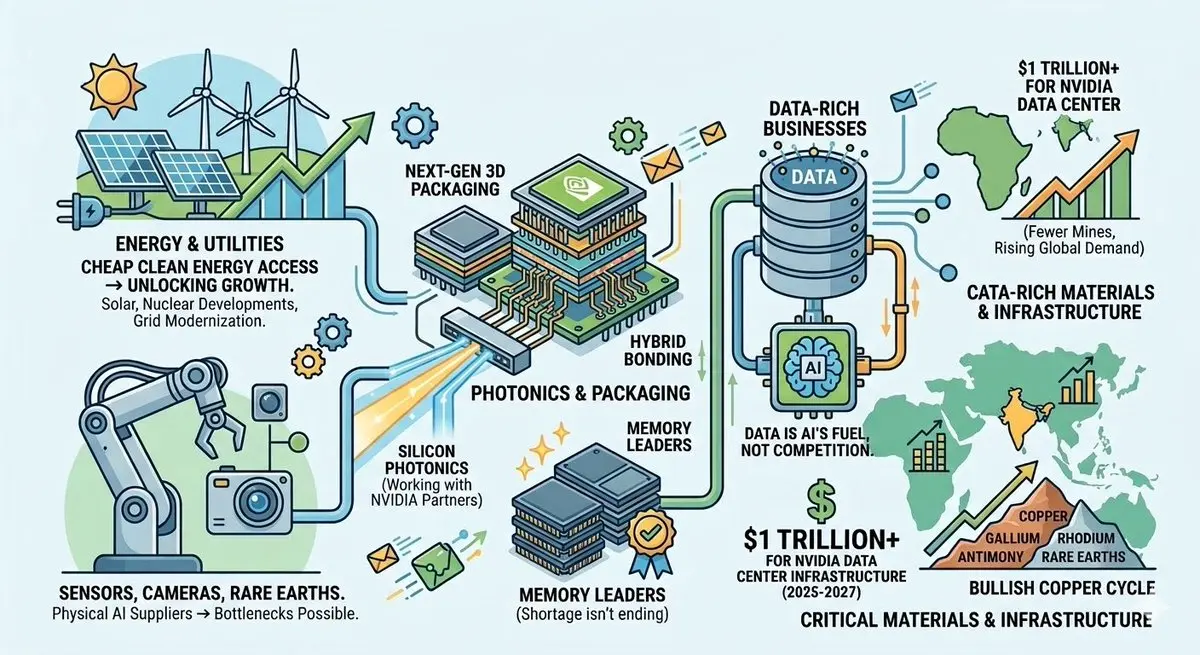
$NVDA has invested so far $5B in Intel | $INTC $2B in Synopsys | $SNPS $2B in CoreWeave | $CRWV $2B in Coherent | $COHR $2B in Lumentum | $LITE $1B in Nokia | $NOK $30m in Nebius | $NBIS $30B in OpenAI $5B in xAI $500M in Wayve €300M in Mistral AI $300M in Crusoe $250M in Scale AI $250M in Cohere $150M in Figure AI $125M in Perplexity $120M in Lambda $100M in Poolside $75M in Together AI $70M in Runway $50M in Waabi $40M in Ayar Labs
RUMOR: $MSFT to be the third gigawatt-scale customer of $AMD According to a report by UBS, $AMD indicated a potential third gigawatt-scale customer beyond its existing agreements with OpenAI and $META. Microsoft appears to be the most likely candidate.
UBS raises $AMD price target to 310 The chipmaker trades at a PEG ratio of 0.46 The firm said AMD indicated a potential third gigawatt-scale customer, likely $MSFT
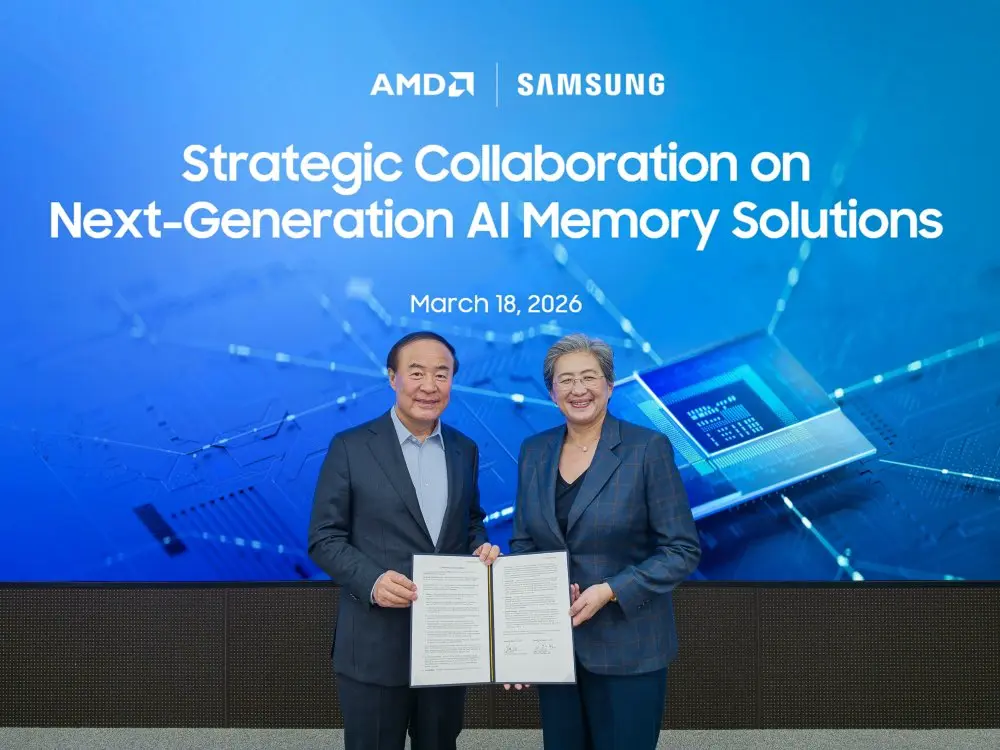
Samsung and $AMD Reinforce Strategic Collaboration to Advance AI-Powered Network Innovations for Commercial Deployments Samsung and AMD say their joint work has moved from testing into real commercial deployments across 5G core, software-based RAN, and private networks They call out a concrete win in Canada: Videotron selected Samsung to deploy 5G NSA and 4G LTE core gateway solutions running on AMD EPYC 9005 Series CPUs, aligned with a cloud-native, AI-ready core strategy At MWC 2026, Samsung plans to demo AI-RAN using its AI-powered vRAN on AMD EPYC, including multi-cell test results aimed a
$VECO and $ACLS merger is interesting $VECO supplies machinery for compound semiconductors, including lasers, plus laser annealing systems and advanced packaging equipment $ACLS supplies ion implantation systems used in memory, logic, power semiconductors, and silicon photonics Together, they could be an interesting company if the synergies actually materialise
$POET and $ALMU look like two companies that could have a $LITE moment sometime in the next 3 years Still, they’re high risk If you’re an investor, why did you decide to get in at such an early stage? $POET 2026 revenue should be ~$10M Interested in hearing some thoughts
$XYZ was always a bloated company Elon Musk showed how much Dorsey overspends This is not a great example of AI taking over 40% of $XYZ employees could have been fired three years ago and nobody would have noticed AI was just a convenient excuse for fixing an obvious issue
$NVDA is at a 4.7T market cap The market is probably nervous that this valuation can only be sustained with multi-hundred-billion-dollar AI CAPEX spending There’s a good chance the Overton window shifts drastically when it comes to valuations Maybe hundreds of billions of dollars in CAPEX isn’t the top the market thinks it is Maybe it’s actually a minuscule amount compared to what could come over the next decade as AI progresses If that happens, $NVDA at 20x 2026 EPS would look very obvious in retrospect
$NVDA destroyed earnings, demolished guidance, and bought one of its largest competitors with pocket change, and the stock is red Imagine what happens if they show even the slightest sign of weakness
Key points from the $NVDA call: > AI is amazing and makes a ton of money. You need compute for AI. More AI means more money, so hyperscaler capex should keep growing from 2027 onward. > Jensen wants the entire AI ecosystem built on top of NVIDIA, which is why they’re investing in so many companies. > The Groq acquisition is being framed as a Mellanox-like move. More details expected at GTC. >Data centers in space have use cases, but they’re not economically feasible in the short term. > Hyperscalers account for over 50% of revenue. > Non-hyperscaler revenue is growing faster than hyperscaler r