InvestingWithBrandon

vip
Age 1.4 Yıl
Peak Tier 0
No content yet
I would rather make one big high conviction trade than 20 small ones.
More trades does not mean more money.
Usually the exact opposite.
High frequency trader:
20 small trades per month.
Little conviction on each one.
Chasing premiums constantly.
Selling when not compelling.
More work. Less money. More stress.
High conviction trader:
1-5 big trades per month when compelling.
Deep research on each one.
Only sell when truly undervalued.
Position sized with real conviction.
Less trades. More money per trade.
Some months I make 1 trade.
Some months I make 20.
It depends on the opportunity.
If I see
post-image
  • Reward
  • Comment
  • Repost
  • Share
Most people think compound interest is simple.
It is not.
$100 at 10% per year for 10 years.
Most people guess $200.
10 years x 10% = 100% gain. Simple math.
Wrong.
You actually end up with $259.
Here is why.
Year 1: 10% of $100 = $10.
Year 7: 10% of $194 = $19.40.
Same percentage. Very different dollar amount.
That is compounding.
You earn interest on the interest.
Time to double at 10%: 7.2 years.
(72 divided by your interest rate = years to double. Memorize this.)
Now flip it to 25% with the options layer.
$100k at 10% for 30 years: $1.7M
$100k at 25% for 30 years: $80M+
Same starting amoun
  • Reward
  • Comment
  • Repost
  • Share
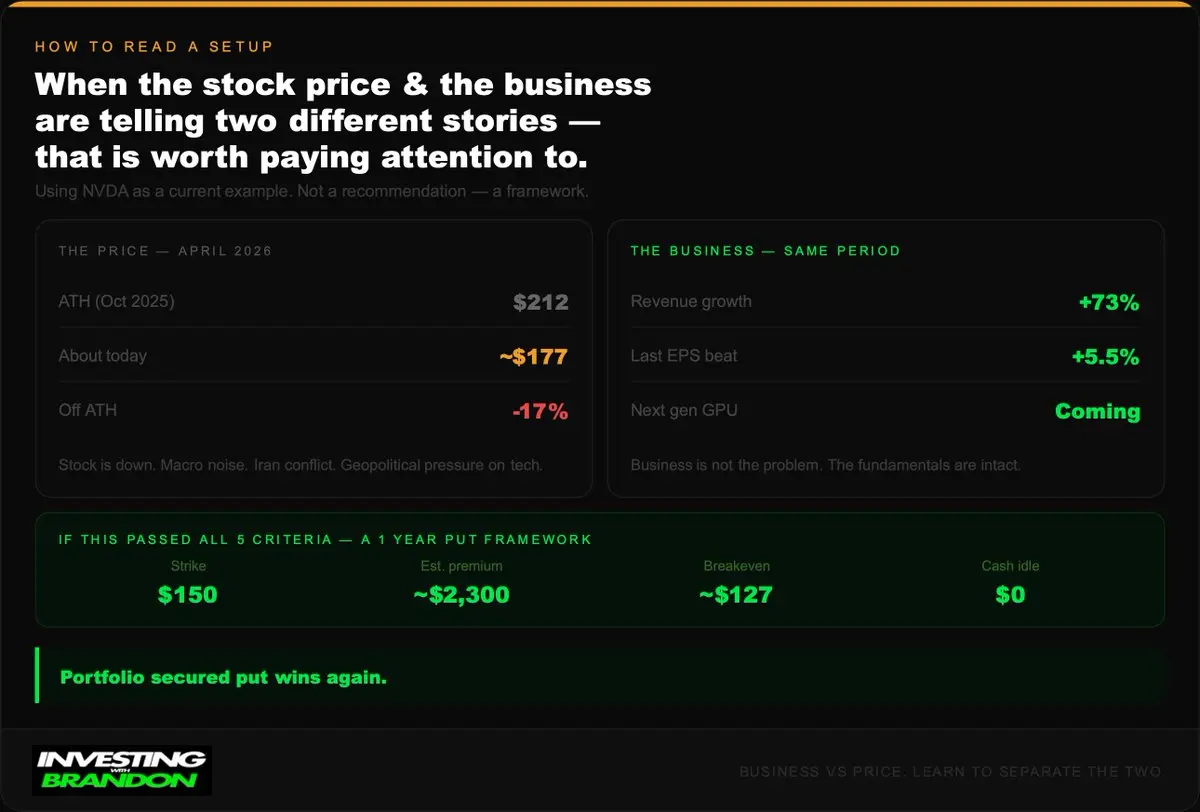
I sold a put on Nvidia.
Here is exactly what happened.
Nvidia was below the EPS growth line.
I acted.
Premium collected instantly: $25,000.
Cash in my account: $0.
What a cash secured put would have needed: $150,000 sitting idle.
What I did with the $25,000:
Bought Nvidia LEAP calls with part of it.
Bought Nvidia shares with the rest.
My base portfolio secured the put.
Not $150,000 in cash.
Every dollar worked on the way up.
Sold put.
Collected premium.
Bought shares & calls.
Everything worked.
Ratios in check to manage risk
That is the whole system in one trade.
Portfolio secured put wins aga
post-image
  • Reward
  • Comment
  • Repost
  • Share
Monthly puts vs 2 year puts.
The math that ends the argument.
Market gets cheap.
I sell one 2 year put. Collect $20,000.
You sell monthly puts on the same company.
$1,000 per month average.
To match my $20,000 you need to hit 20 trades in a row.
But here is the problem.
As the market recovers from the dip each monthly put becomes less compelling.
Less undervalued. Less premium. Less margin of safety.
You are forcing trades as the opportunity shrinks.
Meanwhile I deployed $20k at peak fear.
Took that premium. Bought LEAPS.
Bought shares.
Done.
One trade at the right time beats 20 trades at the
post-image
  • Reward
  • Comment
  • Repost
  • Share
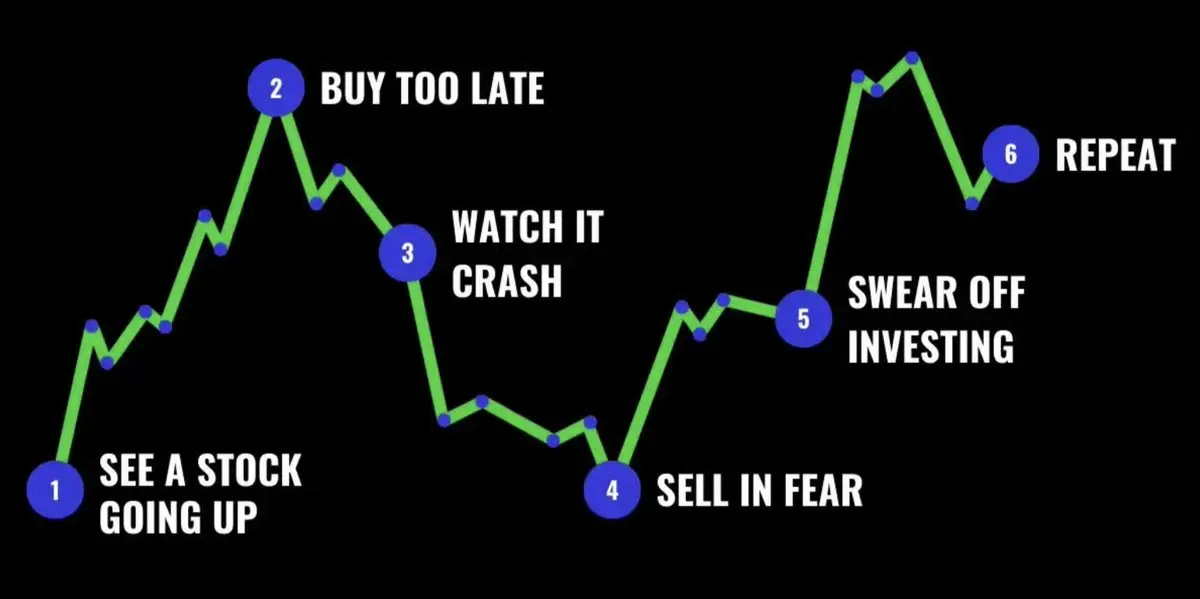
94% of day traders do not make it.
I know because I was one of them at the start.
Here is what they all get wrong.
At a day job more hours = more money.
They carry that mindset into trading.
More trades = more money.
It is the complete opposite.
A day trader buys a 10-day call option.
That contract loses 10% of its value every single day the stock does nothing.
Your direction has to be right.
Your timing has to be pinpoint.
You have to know what Trump is going to tweet.
You cannot know any of that.
Nobody can.
I buy 1-2 year LEAPS on quality companies below intrinsic value.
Earnings per share
  • Reward
  • Comment
  • Repost
  • Share
Your car payment is costing you $5.1 million.
$800 per month car payment.
40 years.
10% annual return if invested instead.
You spend: $384,000 on car payments over 40 years.
If invested instead: $5.1 million.
Is the car worth $5.1 million to you?
For me the answer is no.
What you could do instead:
Buy a quality used car for $10,000 cash.
Do it 4 times over 40 years. Total spent: $40,000.
$40,000 on cars vs $5.1M in the portfolio.
I could buy a Lambo right now.
I could buy a plane right now.
That money is compounding instead.
Boring car (I drive a Tesla FSD is great).
7 figure account.
Easy c
post-image
  • Reward
  • Comment
  • Repost
  • Share
The wheel strategy sounds good on paper.
Sell a put. Get assigned. Sell covered calls. Repeat.
Here is the problem.
You sell a $600 Q put. Collect $682.
The cash securing that trade? $60,000 sitting idle.
That is 1% per month. 12% annualized.
Meanwhile the NASDAQ went up 134% in 3 years.
You did all that work.
You stressed about every earnings report.
You hit trade after trade after trade.
You underperformed buy-and-hold by 90% in 3 years.
And when the market falls 35% you are not in capitalization mode.
You are in survival mode.
Trying to wheel out of assigned shares.
Missing the entire rebou
  • Reward
  • Comment
  • Repost
  • Share
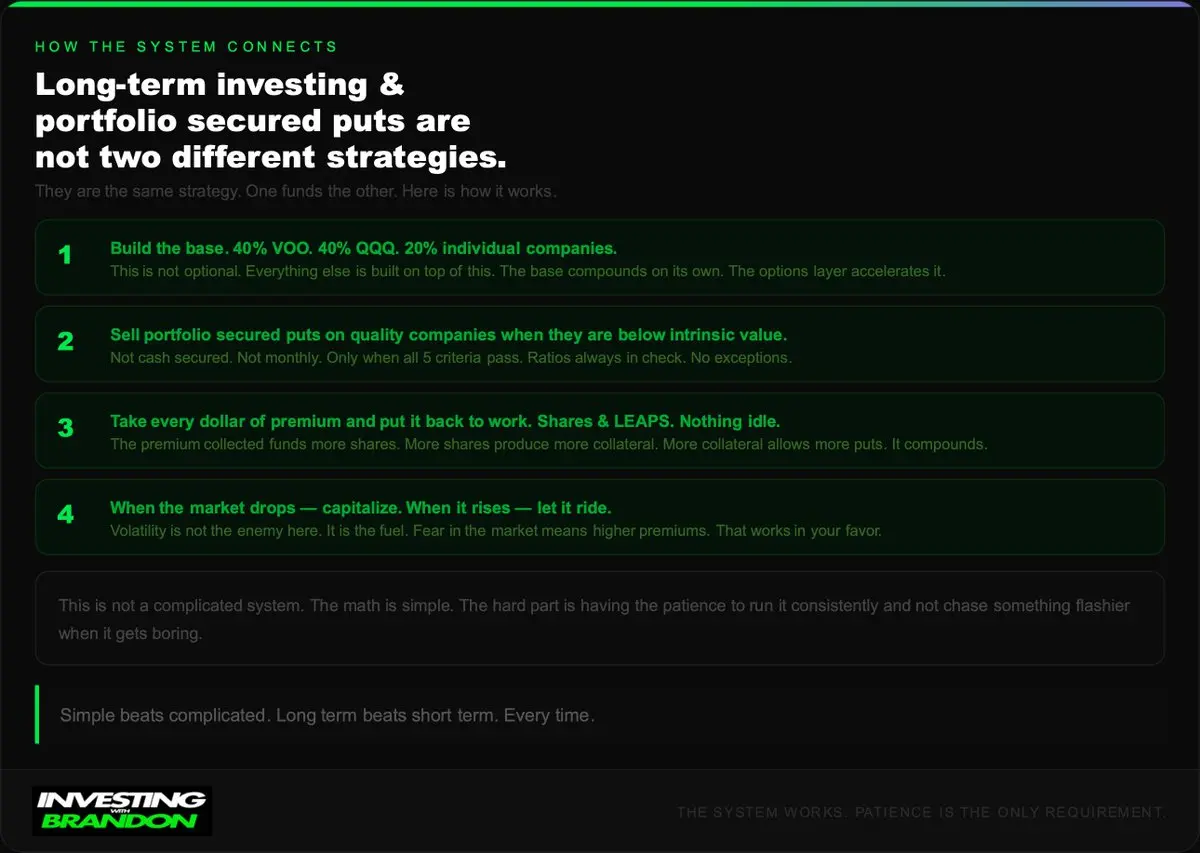
How I retired at 31 selling portfolio secured puts.
Not cash secured puts.
Not covered calls.
Not spreads.
This exact system.
Step 1. Evaluate the macro first.
Overall market valuation. Economic picture. PE ratio. Interest rates. Ect...
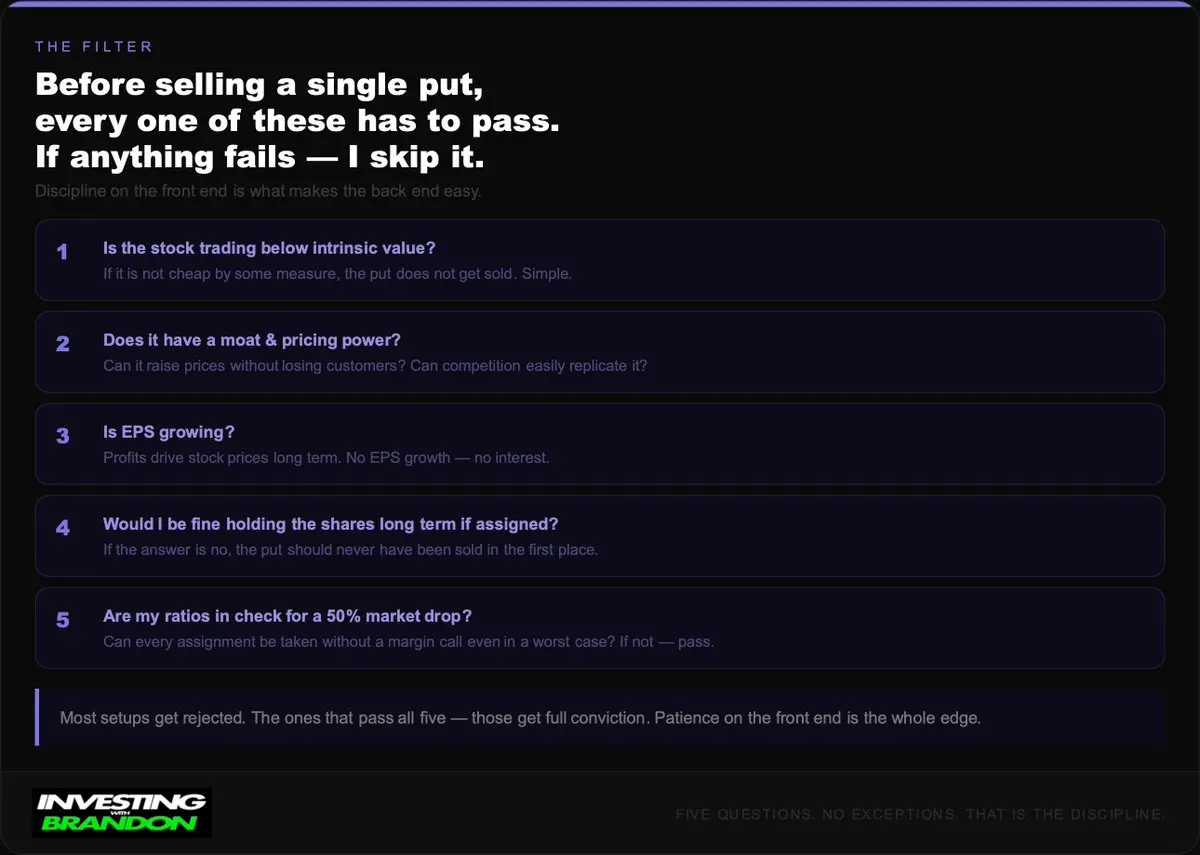
Step 2. Find a quality company at a good price.
EPS growing. Moat. Pricing power.
Trading at or below intrinsic value.
Stock below the EPS growth line.
Step 3. Sell 1-2 year portfolio secured put.
Not cash secured.
10% below an already undervalued price.
Base portfolio is the collateral.
Zero margin interest. Zero cash sitting idle. Ratios & risk managed to be
post-image
  • Reward
  • Comment
  • Repost
  • Share
The cost of waiting just 5 years to start investing.
Same $1,000 per month. Same 10% ROI. Same 25 years.
Start now: $1.3M
Wait 5 years: $762K
Cost of waiting: $546K gone forever.
"Once I pay off my car I will start investing."
That 5 year delay just cost you over half a million dollars.
Now flip it to 20% ROI with the options layer.
10% ROI over 25 years: $1.2M
20% ROI over 25 years: $5.7M
Same contributions. Same time horizon.
Compounding does the rest.
You only have to get rich once.
Start now.
Every year you wait is compounding that is gone forever.
There is no catching up.
post-image
  • Reward
  • Comment
  • Repost
  • Share
If you get value from my posts, you'll love my 10 Day Stock & Options Transformation Training.
No day trading.
No swing trading.
No BS.
Just straight up investing the right way.
Over the course of 10 days of training (you can do it faster if you want), you'll learn exactly how you can scale your portfolio to millions with Stocks & Options in a low risk way & get access to my mastermind Discord community.
This is the exact same system I have used for the last decade & scaled to millions with tens of thousands in monthly cash flow in a low risk way.
Get set up here:
  • Reward
  • Comment
  • Repost
  • Share
Analysis paralysis could cost you more than a bad trade.
At some point you have to pull the trigger.
Waiting for the perfect setup:
You are never going to get a perfect entry.
You will always wish you bought slightly cheaper.
Hindsight is always 20/20.
Not starting is the biggest risk:
Staying in your day job until 70 is riskier than making an imperfect trade on a quality company at a fair price.
What actually matters:
Buy quality companies at good prices.
Keep ratios in check.
Stay in the game.
Make more than you lose.
Beat the S&P.
That is the whole thing.
You will never know everything.
Sta
post-image
  • Reward
  • Comment
  • Repost
  • Share
The easiest way to know if the market is cheap or expensive.
One number. Free. Updated every week.
Go to Google.
Type "S&P 500 PE ratio Yardeni."
Click the first result.
Here is how to read it.
PE above 20-22:
Market is a little expensive. Future returns likely muted. De-risk a little. Less bullish options. Keep powder dry.
PE around 17-19:
Historical average. Fair value. Keep building the base portfolio & allocating options on ultra compelling setups.
PE below 14:
Market is cheap. Deploy capital. Sell portfolio secured puts. Buy calls. Keep ratios in check.
PE ratio is not the end all be all
post-image
  • Reward
  • Comment
  • Repost
  • Share
Most people read earnings reports completely wrong.
Two things matter. Everything else is noise.
What most people focus on:
"They beat earnings."
Beat against what? Analyst expectations.
Apple beats the $1.50 expectation with $1.53.
But the quarter before was $2.18.
3 quarters in a row going down. Nobody mentions that.
What actually matters:
1. Is EPS growing quarter over quarter?
Not beating analyst guesses. Actually growing vs prior quarters.
2. What is the guidance?
Markets are 6-12 months forward looking.
Good quarter with bad guidance = stock falls.
Every time.
Always get your information
  • Reward
  • Comment
  • Repost
  • Share
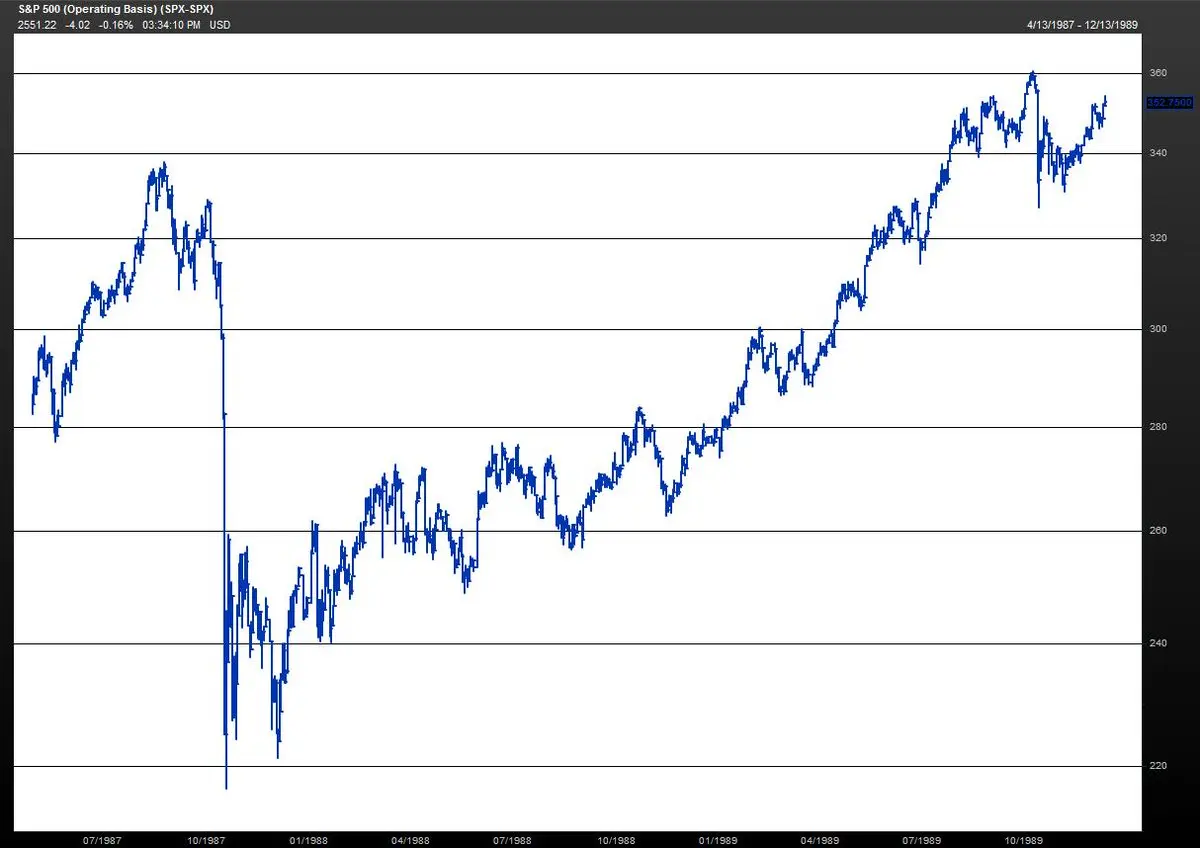
Bull markets last 9.1 years on average.
Bear markets last 1.4 years on average.
Since 1926. Let that sink in.
Average bull market: +476% cumulative return.
Average bear market: -41% cumulative loss.
What this means for how I invest:
The bulls win in the long run. That is a 100 year fact.
Bear markets are shorter and shallower on average.
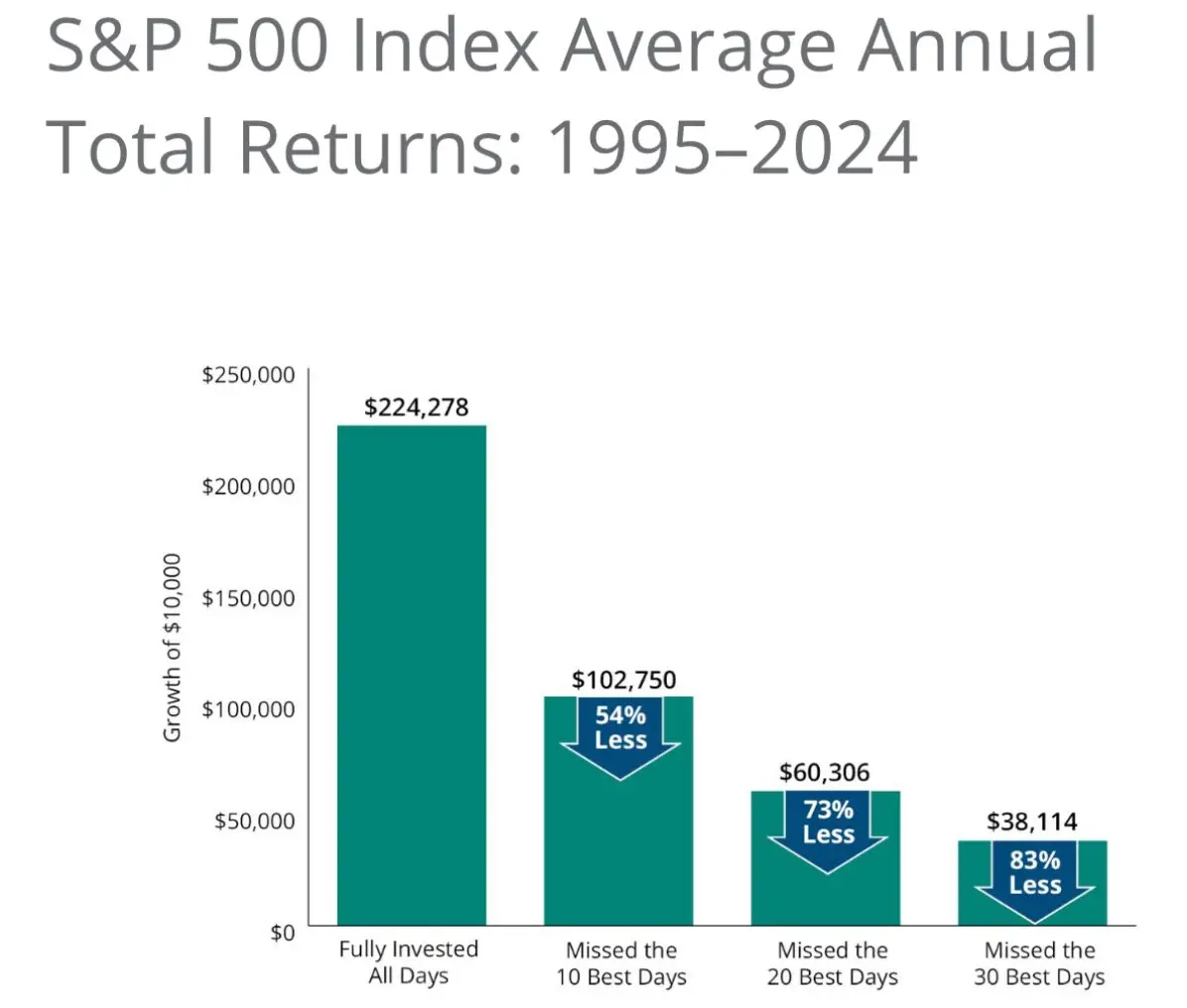
So I stay invested.
I add during bear markets.
I never panic sell.
I keep ratios in check so I can always survive the dip.
The bet I make every single day:
America goes up over time.
If I am wrong about that we have bigger problems than our portfolio.
post-image
  • Reward
  • Comment
  • Repost
  • Share
Here is exactly what returns to expect from this strategy I do.
Most people set expectations too high or too low. Here is the honest math.
Base portfolio target: ~10% per year.
Historical S&P 500 average. Some years 50%. Some years -50%. Zoom out.
Options layer target: ~15% per year on top.
Only when undervalued. Quality companies. Long duration. Ratios in check.
Combined total target: ~25% per year.
My actual 10 year CAGR: 25.89%. Beat S&P (15%) and Nasdaq (18%).
The critical warning.
If you go from $100 to $50 that is a 50% drop.
To get back to $100 from $50 you need a 100% gain.
Never get w
post-image
  • Reward
  • Comment
  • Repost
  • Share
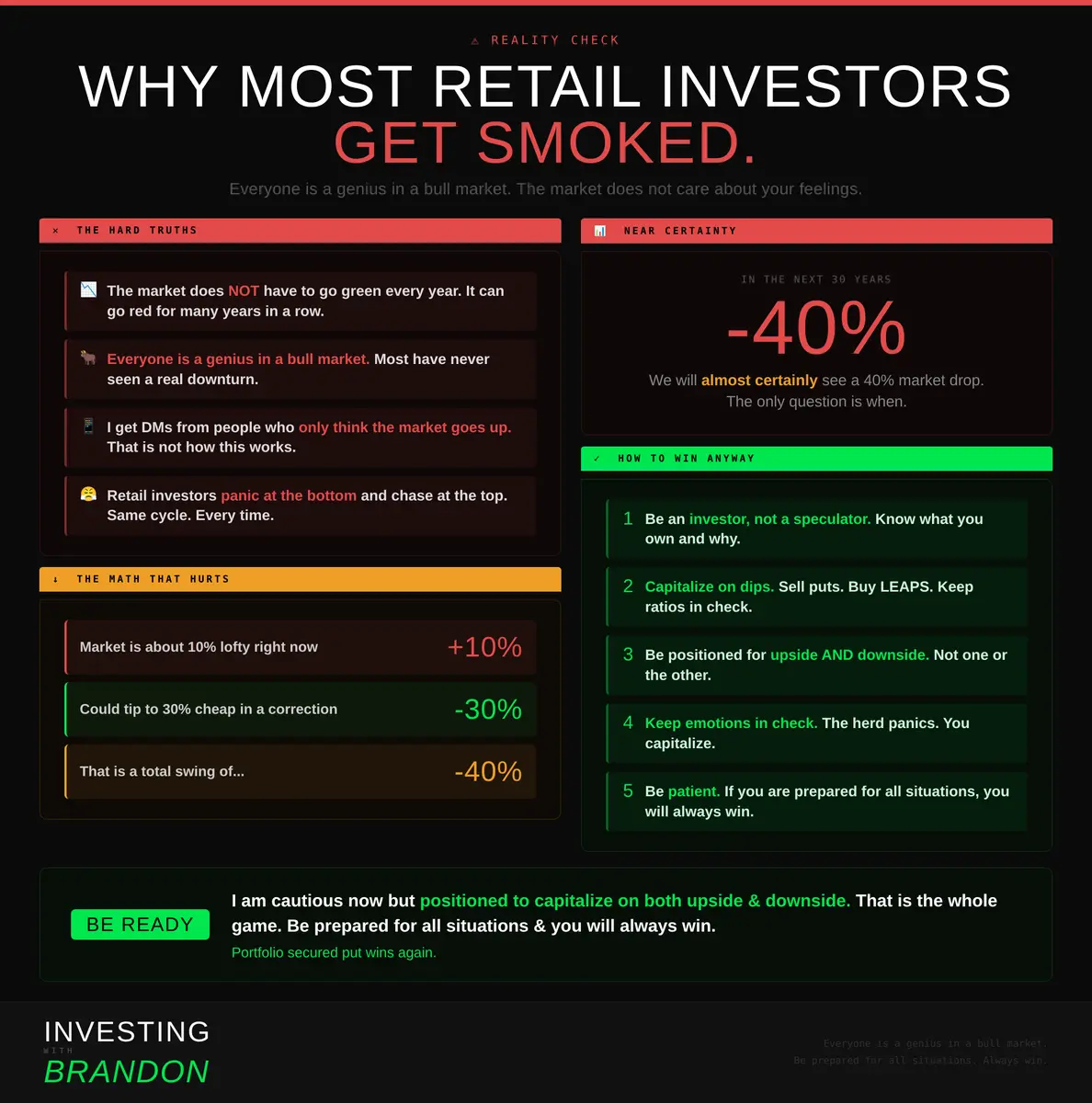
Most people think bull markets and bear markets are random.
They usually are not.
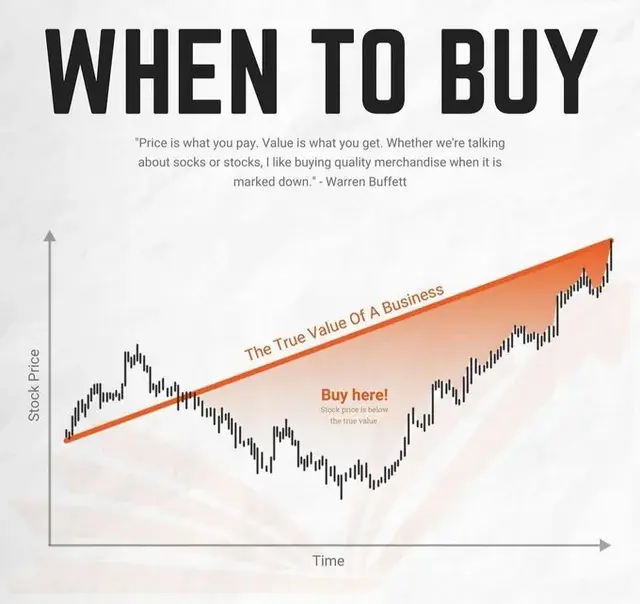
The market follows EPS up and to the right in the long run.
When it gets stretched too far above the line — it snaps back.
When it gets stretched too far below the line — it snaps back up.
That is it. That is the whole game.
1999 — market was 24-25x PE.
Way above the line. Crashed 50%.
2022 — market stretched above the line.
Fell 35%.
Right now — market is a little above the line. Future returns will likely be below trend.
You do not have to call the exact top.
You do not have to call the exact bottom.
You just
post-image
  • Reward
  • Comment
  • Repost
  • Share
Nobody talks about the 9-5 trap honestly.
Here it is.
Your boss pays you just enough so you do not quit.
You work just enough so you do not get fired.
That is the whole relationship in one sentence.
There is a ceiling on every salary.
You cannot negotiate your way to $10M.
You cannot work hard enough to get there.
There are only 24 hours in a day.
With stocks & options there is no ceiling.
You want to make 10x more?
Add a zero behind the trade.
Same amount of time.
Same amount of work.
10x the position.
(of course do in reason and keep ratios in check. My point is it's no more work)
The goa
post-image
  • Reward
  • 1
  • Repost
  • Share
CryptoSpectovip:
To The Moon 🌕
Option Greeks tell you almost nothing useful.
Delta. Theta. Gamma. Vega. Rho.
Here is what delta actually factors in:
Historical volatility.
Time left in contract.
Interest rates.
Directionality.
Here is what delta does NOT factor in:
EPS growth rate.
Revenue trajectory.
Whether the company has a moat.
Whether the market is a bubble.
Whether competition is about to eat the company alive.
You are looking through a microscope at 4 things.
Missing the whole picture.
Warren Buffett probably does not even know what delta is.
He just buys good companies at good prices and is patient.
Delta tells you
post-image
  • Reward
  • Comment
  • Repost
  • Share
I tracked 5 options strategies over 10 years.
Here is how they ranked.
D tier — Covered calls.
Bullish with one hand. Bearish with the other.
You cap your upside on the exact companies you love most.
NVIDIA went up 10x. Covered call sellers missed most of it.
C tier — Cash secured puts.
Right idea. Wrong execution.
All that cash sitting there doing nothing while you are bullish.
B tier — Buying puts.
Hard to be consistently right on timing AND direction.
Theta eats you alive while you wait to be right.
A tier — Buying long duration calls.
Works well when cheap. Still requires timing.
S tier —
post-image
  • Reward
  • Comment
  • Repost
  • Share
  • Pin